Loan-to-value (LTV) calculator
Loan-to-value is the size of your mortgage as a percentage of the property's value. Lenders price mortgages in LTV bands rather than on a sliding scale, so which side of a threshold you land on can matter more than the size of your deposit.
Loan-to-value
85.0%
Standard band
Rate band
85% LTV
Rates slightly higher than 80%
Deposit
15.0%
Your share of the property value
How loan-to-value is calculated
The formula is the simplest on this site:
LTV = (mortgage ÷ property value) × 100
On a purchase, the mortgage is the price minus your deposit, and the property value is the lower of the agreed price and the lender's own valuation. On a remortgage, the mortgage is your outstanding balance and the value is whatever the lender's valuation says the property is now worth — not what you paid for it, and not what the portal estimate says.
LTV is the lender's measure of risk. If you default and the property has to be sold, the lender needs the sale to cover the debt plus costs. A borrower with a 40% deposit gives them an enormous cushion; a borrower with a 5% deposit gives them almost none. The price of the mortgage reflects that, which is why LTV drives your rate more than almost anything else about you.
A worked example, step by step
Worked example
A £300,000 property with a £45,000 deposit
- Work out the loan: £300,000 − £45,000 = £255,000.
- Divide by the value: £255,000 ÷ £300,000 = 0.85.
- Multiply by 100: 85.0% LTV, which is a 15% deposit.
- Find another £15,000 of deposit and the loan drops to £240,000, which is 80.0% LTV — a different, cheaper band.
Loan-to-value: 85.0% (a 15% deposit)
Why that last step matters: on a £255,000 mortgage over 25 years, a rate that is 0.25 percentage points lower saves about £36 a month, and 0.3 points saves about £44 a month. Over a five-year fixed deal, moving down one band is commonly worth a few thousand pounds — for a deposit increase that may be much smaller than the gap between the bands suggests.
Deposit and LTV are two ways of saying the same thing
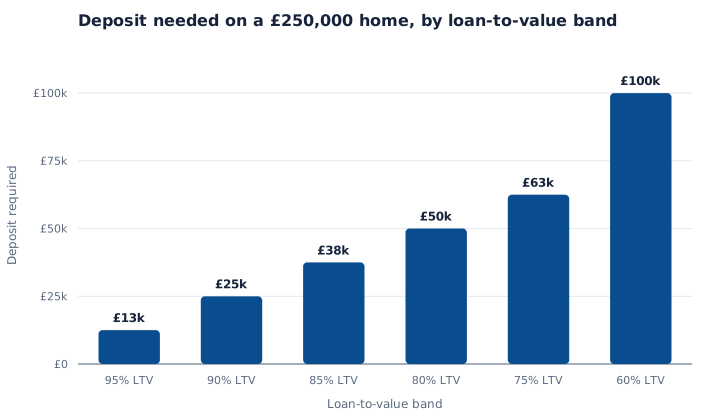
| LTV | Deposit % | Deposit needed | Mortgage |
|---|---|---|---|
| 60% | 40% | £120,000 | £180,000 |
| 75% | 25% | £75,000 | £225,000 |
| 80% | 20% | £60,000 | £240,000 |
| 85% | 15% | £45,000 | £255,000 |
| 90% | 10% | £30,000 | £270,000 |
| 95% | 5% | £15,000 | £285,000 |
Why the bands matter more than the number
Lenders do not price LTV on a smooth curve. They set thresholds — commonly at 60%, 75%, 80%, 85%, 90% and 95% — and everything between two thresholds is charged at the higher one's rate. A borrower at 80.4% LTV pays exactly the same as a borrower at 84.9%, and noticeably more than a borrower at 79.9%.
The practical consequence is that the marginal value of deposit money is wildly uneven. Going from a 14% to a 15% deposit changes very little. Going from 19.6% to 20.1% can change your rate for five years. Before you fix your offer or your deposit, it is worth checking where the nearest threshold sits and whether a small adjustment gets you under it.
What the result does and does not tell you
- A down valuation changes everything. If the lender values the property below the agreed price, the LTV is calculated on their figure. You either find more deposit, renegotiate the price, or accept a worse rate band.
- It does not include fees added to the loan. Adding a product fee increases the mortgage but not the value, nudging the LTV up. If you are close to a threshold, pay the fee upfront.
- Equity is not the same as available deposit. On a house move, your equity has to cover stamp duty, legal fees, estate agency and moving costs before any of it becomes deposit on the next property.
- New-build incentives are usually deducted. Developer contributions such as paid stamp duty, cashback or free upgrades are often taken off the purchase price for lending purposes, which raises the effective LTV.
- LTV says nothing about affordability. A 50% LTV mortgage you cannot afford will still be declined. The two tests are separate and you have to pass both.
What lenders do differently from this model
Beyond the valuation point, lenders apply several adjustments that a simple ratio cannot capture. Maximum LTV is often reduced for flats, new builds, interest-only lending, buy-to-let, non-standard construction, properties above commercial premises and ex-local-authority high-rise blocks. Some lenders cap LTV by loan size, so large loans require proportionally bigger deposits. Others restrict the maximum LTV where any part of the deposit is gifted, or where the applicant has adverse credit.
On remortgages, lenders differ in how they value: some use an automated valuation model based on sold prices, others send a surveyor. The same property can land in different LTV bands with different lenders on the same day, which is one of the more useful things a broker can navigate for you.
When it is worth speaking to a broker
Get advice if you are sitting within a percentage point or two of a band threshold; if you are buying a flat, a new build or anything non-standard where the maximum LTV may be reduced; if you are at 90% or above, where the choice is narrow and criteria matter; if a valuation has come in low and you need to know which lenders might value it differently; or if part of your deposit is gifted or comes from a source lenders scrutinise.
High-LTV lending is also where the difference between the best and worst available product is widest, simply because fewer lenders compete there. It is the point in the market where advice tends to pay for itself most reliably.
Frequently asked questions
- How do you calculate loan-to-value?
- Divide the mortgage by the property value and multiply by 100. A £255,000 mortgage on a £300,000 property is 255,000 ÷ 300,000 × 100 = 85% LTV. On a purchase, lenders use the lower of the agreed price and their own valuation, so a down valuation raises your LTV even though nothing about your deposit has changed.
- What is a good loan-to-value ratio?
- Below 60% gives you access to the widest choice and the sharpest pricing. Between 60% and 80% is comfortable and well served by nearly every lender. Above 90% the choice narrows and rates rise noticeably. The practical goal is to land just under a band threshold rather than just over one.
- Why does 80.1% LTV cost more than 80%?
- Lenders price in bands, not on a sliding scale, so everything from 80.01% to 85% is charged at the 85% rate. Crossing a threshold by a fraction of a percent moves you into an entirely different price bracket. Finding a few hundred pounds more deposit to stay under a threshold can be worth thousands over a deal period.
- Does loan-to-value change over time?
- Yes, in two ways. Your balance falls as you repay capital, and the property value moves with the market. Both push your LTV around. That is why a remortgage two years after purchase often lands in a cheaper band than the original mortgage, even without overpaying.
- Can I get a mortgage above 95% LTV?
- Options above 95% are limited and specialist. They generally depend on additional security — a family member's savings or a charge over their property under a guarantor or springboard arrangement — rather than on standard lending. Rates are higher and criteria are tighter, so advice is close to essential.
- Does adding the product fee to my mortgage change my LTV?
- It can. Adding a fee of, say, £999 increases the loan without increasing the property value, so the LTV rises slightly. If you are sitting just under a band threshold that small increase can tip you over it and into a more expensive bracket, which costs far more than paying the fee upfront.
Keep going
These are the tools and guides people most often need next.
- Loan-to-value explained — the longer guide to bands, valuations and equity.
- Help with a mortgage deposit — practical routes to a bigger deposit and a lower LTV.
- Valuation vs survey — what the lender's valuation is actually for.
Guide only. This calculator gives an illustrative estimate and is not regulated mortgage advice or a personal recommendation. Actual figures depend on the lender, product, term, credit profile and your circumstances. Only an FCA-authorised adviser can recommend a product for you. Your home may be repossessed if you do not keep up repayments on your mortgage.
A guide only. Lender LTV bands and pricing vary between lenders and change with the market. A qualified mortgage broker or adviser can tell you which products are actually available at your LTV and in your circumstances.
Want a real quote?
Browse independent brokers and advisers who specialise in your situation.
Find a mortgage broker