5 min read · Updated
How to build a mortgage deposit faster
Practical ways to get a deposit together sooner: Lifetime ISA versus regular savers, family gifts, guarantor and joint borrower sole proprietor mortgages, with worked timelines and numbers.
Written and reviewed by the MortgageMatch editorial team. How we research and review our guides.
The fastest legitimate ways to build a deposit are to cut your largest recurring cost (usually rent), automate a fixed monthly transfer on payday, and use a Lifetime ISA if you qualify, because the 25% government bonus adds up to 1,000 pounds a year on top of whatever interest you earn. Beyond that, most people get there sooner through family help, a joint purchase, or a guarantor-style mortgage rather than through saving alone.
Start by fixing the target, not the habit
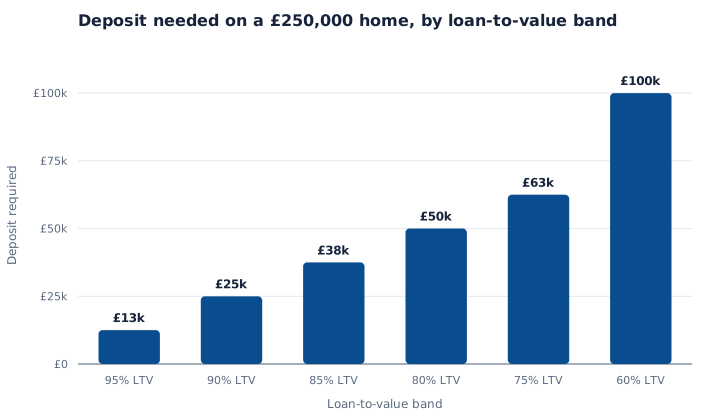
A vague goal produces vague saving. Work out the actual number first.
On a 250,000 pound home, 5% is 12,500 pounds and 10% is 25,000 pounds. Add roughly 3,000 pounds for conveyancing, searches and a survey. So a realistic 10% target is 28,000 pounds, not 25,000.
Now divide by the months you are willing to wait. Saving 28,000 pounds in three years means 778 pounds a month. In four years it means 583 pounds. If neither is possible on your income, the honest conclusion is that pure saving is not your route, and you should read the family help and guarantor sections below rather than grinding away at a target you will not reach.
Lifetime ISA versus a regular saver
These do different jobs and the right answer is usually both.
A Lifetime ISA is the strongest option for most first-time buyers who qualify. You must be 18 to 39 to open one. You can pay in up to 4,000 pounds per tax year, which counts within your overall ISA allowance, and the government adds a 25% bonus of up to 1,000 pounds a year. You can keep contributing until you are 50. The catch is a set of conditions: the property must cost 450,000 pounds or less, you must be a first-time buyer buying with a mortgage, and the account must have been open at least 12 months before you can use it for a first home. Take money out for any other reason before 60 and you pay a 25% government withdrawal charge, which can leave you with less than you paid in.
A regular saver account, by contrast, usually pays a headline interest rate on a limited monthly deposit for twelve months, with no restrictions on what you do with the money. It is flexible and it is the right home for the part of your fund you might need for fees, or if there is any chance you will buy above 450,000 pounds.
A sensible split for someone saving 600 pounds a month: 333 pounds a month into the Lifetime ISA (which is 4,000 pounds over the year and earns the full 1,000 pound bonus) and the remaining 267 pounds into a regular saver or easy access account for fees and emergencies.
The two-year worked example
Take a couple both aged 28, saving jointly, renting for 1,100 pounds a month.
- Both open a Lifetime ISA and pay in 4,000 pounds each per tax year. That is 8,000 pounds of contributions plus 2,000 pounds of bonus a year, so 20,000 pounds over two years.
- They add 250 pounds a month between them into an easy access account, which is another 6,000 pounds over two years plus a little interest.
- Total after two years: around 26,000 pounds.
That is a 10% deposit on a 260,000 pound purchase with a couple of thousand left for fees. Without the Lifetime ISA bonus they would be roughly 4,000 pounds short, which is around six months of extra saving.
Cutting the cost that actually moves the needle
Small economies rarely close a 25,000 pound gap. Big structural changes do.
Moving in with family for a year, if that is available to you and genuinely workable, is worth roughly 13,000 pounds against a 1,100 pound rent. Moving to a cheaper flat or taking a lodger under the Rent a Room scheme (which lets you receive rental income from a lodger in your own home tax free up to a set annual threshold, so check the current figure on GOV.UK) can free up several hundred pounds a month.
Switching your monthly saving to leave your account the day you are paid rather than at the end of the month is the single highest-return behavioural change, because it removes the decision entirely.
Be careful about the reverse trade too. If you have a personal loan costing 300 pounds a month, clearing it usually increases your maximum mortgage by more than the same money adds to your deposit, and it improves your affordability assessment at the same time.
Family help without a gift
Not every family has a spare 20,000 pounds. Several products let relatives help with money they keep.
A guarantor mortgage lets a family member take on legal responsibility for the payments if you cannot make them. It is a serious commitment and the guarantor should take independent advice.
A joint borrower sole proprietor arrangement, usually shortened to JBSP, is now more common. A parent's income is included in the affordability calculation, so you can borrow more, but only you go on the title deeds. That matters because the parent is not a property owner, which avoids the higher rate of property tax that usually applies to additional properties. The parent is still fully liable for the debt, so it is not a free favour.
Family deposit or offset arrangements work differently again. A relative puts a lump sum, often 10% of the purchase price, into a linked savings account for a fixed period of several years. It sits as security. If you keep up payments, they get it back, sometimes with interest. Availability, terms and the exact mechanics vary a lot between lenders.
If a relative is simply giving you money, that is a gifted deposit and it comes with its own paperwork requirements around gift letters, donor identification and source of funds.
What to avoid
- Do not borrow your deposit on a credit card or personal loan. Lenders check, the new debt reduces your affordability, and most will decline outright.
- Do not put deposit money into a stocks and shares account if you plan to buy within three years. A 15% fall six months before you buy is a real risk and it has happened to plenty of people.
- Do not leave your deposit in cash for four years without checking the interest rate. Rates on legacy accounts drift down and inflation erodes what is left.
- Do not open several new credit accounts in the six months before you apply.
A realistic timeline
For most people on an average income, building a 10% deposit from nothing takes three to five years without help, and one to two years with a Lifetime ISA and a lower cost of living. With a family gift or a JBSP arrangement, the timeline is set by whenever that help is available rather than by your saving rate.
Whichever route fits, it is worth talking to a broker before you finish saving rather than after, because knowing the deposit figure that actually unlocks a better rate band changes your target. The MortgageMatch directory lists FCA-authorised brokers who can run that calculation with you.
Frequently asked questions
- How long does it take to save a mortgage deposit in the UK?
- For a 10% deposit of around 25,000 pounds on a 250,000 pound home, saving 600 pounds a month takes roughly three and a half years, or closer to two and a half years if you use a Lifetime ISA and collect the full 1,000 pound annual bonus. Cutting rent by moving in with family or taking a lodger shortens it more than trimming everyday spending.
- Is a Lifetime ISA better than a regular savings account for a deposit?
- For most eligible first-time buyers, yes, because a 25% government bonus of up to 1,000 pounds a year beats any savings rate. The trade-off is inflexibility: the property must cost 450,000 pounds or less, the account must be open at least 12 months, and withdrawing for anything else before 60 triggers a 25% charge that can leave you with less than you put in.
- Can I borrow money for a mortgage deposit?
- Not from a credit card or personal loan. Lenders require evidence of where your deposit came from and will usually decline if it is borrowed, partly because the new repayment reduces your affordability. A gift from a family member is acceptable with a signed gift letter confirming it is not repayable, and some lenders accept a formal loan from an employer.
- What is a joint borrower sole proprietor mortgage?
- It is an arrangement where a family member's income is counted in the affordability assessment so you can borrow more, but only you are named on the title deeds. Because the helper is not an owner, it usually avoids the additional property tax rate that applies to second homes. The helper remains fully liable for the mortgage debt, so independent advice matters.
- Should I clear debts or save for a deposit first?
- Usually clear expensive short-term debt first. A 300 pound monthly credit commitment can reduce your maximum mortgage by 15,000 to 20,000 pounds depending on the lender, which is more than the same money would add as deposit. It also improves how underwriters read your file. Long-term low-rate debt such as a student loan is treated differently and rarely worth rushing.
This guide is general information about how UK mortgages work, not a personal recommendation. Only an FCA-authorised adviser can recommend a product for your circumstances. Tax and scheme rules change, so check the relevant government source before you budget.
Related guides
- First-time buyer? A plain-English mortgage guideThe whole first-time buyer journey in order: deposit, affordability, agreement in principle, application, valuation, mortgage offer and completion, with real numbers and typical timescales.
- Gifted deposits and mortgages: rules and paperworkWhat lenders and conveyancers actually require when a family member gifts your deposit: the gift letter, donor ID, source of funds evidence, non-repayable declarations, and where inheritance tax fits in.
- Using a Lifetime ISA to buy your first homeHow the Lifetime ISA works for a first property: the 25% bonus, the 450,000 pound price cap, the 12-month rule, the withdrawal charge, and how it compares with saving into a pension.