5 min read · Updated
LTV explained: how loan-to-value affects your mortgage rate
What loan-to-value means, why lenders price it in bands at 60, 75, 80, 85, 90 and 95 per cent, and how overpayments, house price movement and downvaluations change the band you land in.
Written and reviewed by the MortgageMatch editorial team. How we research and review our guides.
Loan to value is the size of your mortgage expressed as a percentage of the property's value. Borrow 180,000 pounds against a 200,000 pound property and your LTV is 90%. It matters because lenders price mortgages in LTV bands rather than on a sliding scale, so crossing a threshold such as 90% down to 85% can move you into a cheaper set of products entirely. Lower LTV means less risk to the lender, and cheaper pricing for you.
How LTV is calculated
Divide the mortgage amount by the property value, then multiply by 100. A 152,000 pound mortgage on a 190,000 pound property is 80% LTV.
Two details trip people up. First, the value used is the lender's valuation, not the price you agreed or what the estate agent down the road thinks. If they disagree, the lender's figure wins. Second, if you add the product fee to the loan, that increases the borrowing and can nudge you over a band boundary. A 999 pound fee added to a mortgage sitting at 79.8% LTV can push you into the next band and cost you far more than the fee itself. Ask for the LTV calculated both ways.
For a purchase, your deposit is the other side of the same coin. A 10% deposit means a 90% LTV mortgage. For a remortgage, it is your equity that matters, meaning the current value minus the outstanding balance.
Why lenders price in bands
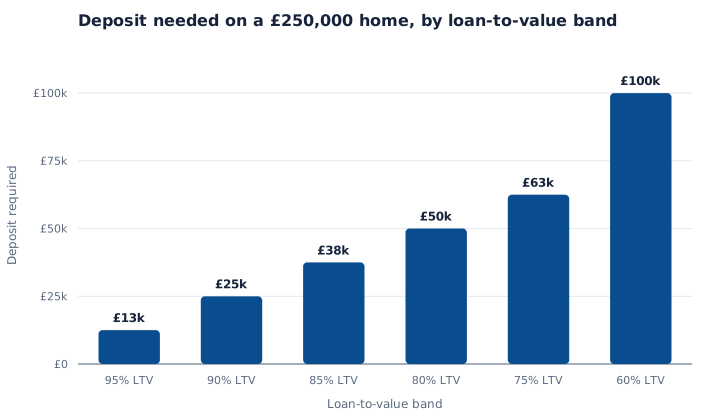
Lenders group products into bands, typically at 60%, 75%, 80%, 85%, 90% and 95%. Not every lender uses every band, and some add their own steps such as 70% or 95% only for specific schemes.
The logic is loss given default. If a lender has to repossess and sell, it needs the sale to cover the debt plus costs. At 60% LTV the property could fall a long way in value and the lender would still be whole. At 95% a modest fall wipes out the buffer. That risk is priced into the rate, and it is why the gap between bands is usually widest at the top end. The difference between 90% and 85% is often more meaningful than the difference between 65% and 60%.
The practical consequence is that being at 85.4% LTV is expensive in a way that 85.0% is not. There is no partial credit. You are either inside the band or you are not.
Worked example: the cash needed to drop a band
Say your property is valued at 300,000 pounds and your outstanding mortgage is 258,000 pounds. That is 86% LTV, so you fall into the 90% band and are priced accordingly.
To reach 85% you need the balance down to 255,000 pounds, which means finding 3,000 pounds. Assume, purely for illustration, that the 90% band products are priced at 5.1% and the 85% band products at 4.8%. These are example figures, not current market rates.
On a 255,000 pound balance over 22 years remaining, that 0.3 percentage point difference is worth roughly 40 pounds a month, or about 480 pounds a year. Over a five year fix that is around 2,400 pounds, from a 3,000 pound lump sum that you still own as equity in your home. Very few savings accounts offer that.
The lesson is to check your LTV before you apply, not after. If you are within a few thousand pounds of a boundary, a modest overpayment before you submit the application can be the highest return decision in the whole process.
How overpayments change your LTV
Every capital overpayment reduces the balance, which reduces the LTV directly. On a repayment mortgage your regular monthly payments are doing this quietly anyway, and the capital element grows every year as the interest element shrinks.
Most lenders let you overpay up to 10% of the balance a year without triggering an early repayment charge, though the allowance and the way it is measured vary by lender, so confirm yours. If you are close to a band and your allowance permits it, timing an overpayment a month or two before your remortgage application is straightforward and effective.
One thing to watch. Overpaying reduces the balance, but the lender only re-prices you when you take a new product. Overpaying in month three of a five year fix does not lower your rate today. It positions you for a better band when the fix ends.
How house price movement changes your LTV
LTV has two moving parts, and the value side is outside your control.
If your 300,000 pound property rises to 330,000 pounds and your balance is 258,000 pounds, your LTV drops from 86% to 78%, and you are into the 80% band without paying anything. If it falls to 275,000 pounds, that same balance becomes 94% LTV and your options narrow sharply.
This is why remortgage timing sometimes rewards patience, and why the equity you have built over several years is often larger than people assume. Before you assume your LTV, get a realistic view of the current value from recent sold prices for genuinely comparable properties on your street, not asking prices.
Improvements can also help, though lenders value the property as it stands rather than crediting you what you spent. A 25,000 pound extension does not automatically add 25,000 pounds of value.
Downvaluations
A downvaluation is when the lender's surveyor values the property below the agreed price or below your own estimate. It is more common than most buyers expect, particularly on new build properties, unusual homes, and in areas where prices have moved quickly.
On a purchase, the lender lends against the lower figure. If you agreed 300,000 pounds with a 10% deposit of 30,000 pounds, a valuation of 285,000 pounds means the lender will advance 90% of 285,000, which is 256,500 rather than 270,000. You either find the extra 13,500 pounds, renegotiate the price, or walk away.
On a remortgage, a downvaluation pushes you into a worse band or, in some cases, means the application no longer fits.
You can usually challenge it. Lenders have a process, and it generally requires evidence rather than opinion, meaning three or more recent comparable sold prices from the same area and property type, with any factual errors in the report clearly identified. Success is not guaranteed, but it is not rare either. If the challenge fails, a different lender using a different surveyor may reach a different figure, which is one of the practical arguments for using a broker who knows which lenders tend to value more generously on particular property types.
What to do with all this
Work out your LTV before you start comparing rates, using a sober valuation and the balance you will actually have at completion. If you are near a boundary, find out exactly how much would take you over the line. Ask whether adding the fee to the loan crosses a band. And when comparing deals, compare the correct band, because a rate you cannot qualify for is not a rate.
An FCA-authorised broker listed in the MortgageMatch directory can tell you which lenders use which bands and where your case sits before an application is submitted.
Frequently asked questions
- What is a good LTV for a mortgage?
- Lower is cheaper. Pricing improves in steps, typically at 90, 85, 80, 75 and 60 per cent, with the biggest savings usually found by dropping below 90 or 85 per cent. Below 60 per cent you generally reach the best pricing a lender offers and further reductions make little difference to the rate, though they still reduce your interest cost.
- How do I work out my loan-to-value?
- Divide your outstanding mortgage balance by the current value of the property, then multiply by 100. A 190,000 pound balance on a 250,000 pound property is 76 per cent. Use the lender's valuation figure where you have one, and include any product fee you plan to add to the loan, because that increases the amount borrowed.
- Does overpaying my mortgage lower my LTV?
- Yes. Capital overpayments reduce the balance, which reduces loan-to-value straight away. It does not lower your interest rate immediately, because lenders only re-price you when you take a new product. What it does is put you into a cheaper band by the time your current deal ends, which can be worth far more than the overpayment.
- What happens if the lender downvalues my property?
- The lender lends against its own valuation, not the price you agreed. On a purchase you would need to make up the shortfall in cash, renegotiate with the seller, or withdraw. On a remortgage you may fall into a more expensive band. You can usually challenge a valuation with recent comparable sold prices, and a different lender may reach a different figure.
- Why is a 95% LTV mortgage more expensive?
- Because the lender has almost no cushion. With a 5 per cent deposit, a small fall in house prices can leave the debt close to or above the property value, so the lender carries more risk if it ever has to repossess and sell. That risk is priced into the interest rate, and the gap between the highest and lowest bands is usually substantial.
This guide is general information about how UK mortgages work, not a personal recommendation. Only an FCA-authorised adviser can recommend a product for your circumstances. Tax and scheme rules change, so check the relevant government source before you budget.
Related guides
- Fixed vs variable rate mortgagesHow fixed, tracker, discount and capped mortgages work in the UK, what 2, 5 and 10 year fixes really trade off, and how early repayment charges and portability affect the choice.
- Interest-only mortgages: who they suitHow interest-only mortgages work in the UK, the repayment vehicles lenders accept, typical income and equity requirements, part-and-part options, and what to do if an interest-only mortgage is maturing.
- How to choose a mortgage broker or adviser you can trustHow to check a UK mortgage broker on the FCA Register, tell whole-of-market from panel and tied advisers, ask the right questions, and spot the warning signs before you hand over any money.