6 min read · Updated
Fixed vs variable rate mortgages
How fixed, tracker, discount and capped mortgages work in the UK, what 2, 5 and 10 year fixes really trade off, and how early repayment charges and portability affect the choice.
Written and reviewed by the MortgageMatch editorial team. How we research and review our guides.
A fixed rate mortgage locks your interest rate for a set period, commonly two, three, five or ten years, so your monthly payment cannot change until that period ends. A variable rate can move. Trackers follow the Bank of England base rate plus a fixed margin, discounts sit a set amount below your lender's own standard variable rate, and the SVR itself changes whenever the lender decides. Fixed buys certainty. Variable buys flexibility, and the possibility that your payments fall.
What you are actually buying with a fixed rate
A fix is a budgeting tool, not a bet you either win or lose. For the length of the deal, the rate on your offer is the rate you pay, whatever the Bank of England does. That matters most if your household budget has little slack, if your income is irregular, or if you simply sleep better knowing the number.
The trade-off is that you give up the upside. If rates fall sharply the month after you complete, you keep paying the old rate until the deal ends, and leaving early usually triggers an early repayment charge.
There is a subtler point too. Lenders price certainty, and the price changes with market expectations rather than following a rule. Do not assume a five year fix is always dearer than a two year fix, or that it is always cheaper. Check what is actually on offer at the time you apply.
Two, five or ten years
The right length is mostly a question about your life, not about forecasting rates.
- A two year fix suits you if something is likely to change soon. You expect to move, your income is about to jump, you are relying on a lender's niche criteria now and expect a cleaner application later, or your loan to value is close to a band boundary and you want to re-price sooner.
- A five year fix suits you if you want a long stretch of stable payments and you are reasonably confident you will stay put, or that the deal can be ported if you do move.
- A ten year fix suits a smaller group. Settled long term home, stable income, a strong dislike of remortgage admin. Read the early repayment charge schedule closely, because ten years is a long time to be tied and lives change.
A shorter fix means facing the market more often, and every remortgage carries admin, possible fees and the risk that your circumstances have worsened in the meantime. A longer fix reduces that frequency but raises the chance you are locked in when you would rather not be.
Trackers: following the base rate
A tracker is base rate plus a stated margin, for a stated period or in some cases for the life of the loan. If base rate is 4% and your margin is 0.75%, you pay 4.75%. When base rate moves, your rate moves, usually from the start of the following month.
The appeal is transparency. The lender cannot quietly hold your rate up when base rate falls, because the margin is contractual. The risk is that your payment can rise more than once in a year, and you need to be able to absorb that without stress.
Some trackers carry no early repayment charge, which is genuinely useful if you expect to repay a lump sum soon, are waiting on a property sale, or want the option to switch to a fix later without penalty. Others carry an ERC just like a fix. Check the individual product rather than assuming.
Watch for a collar or floor, a level below which your rate will not fall even if base rate does. Not every tracker has one, but they exist and they are easy to miss.
Discount rates and the SVR
A discount variable rate is a set reduction from your lender's standard variable rate, for example SVR minus 1.5%. The catch is that the lender sets the SVR. It is not contractually tied to base rate, so a lender can move it by a different amount, at a different time, or for reasons connected to its own funding costs.
The SVR is also where you land automatically when a deal ends and you do nothing. It is usually the most expensive place in a lender's range to sit, and the gap can be wide. Drifting onto SVR for six months while you get round to remortgaging is one of the more expensive forms of procrastination in personal finance. Start looking three to six months before your deal ends.
Capped rates and hybrids
A capped rate is variable but with a ceiling. It can fall, but it cannot rise above the stated cap. Availability comes and goes, and the cap is priced in, so you often start higher than on a comparable tracker. Some lenders also allow a split, part fixed and part tracker, which gives you a blend rather than an all or nothing decision. What is available varies by lender and over time.
Early repayment charges and portability
Almost every fixed and discounted deal carries an early repayment charge during the deal period. It is typically a percentage of the amount repaid, and it usually steps down each year of the deal. Overpay beyond your allowance, redeem the mortgage, or switch lender before the end date, and it bites. Most lenders permit overpayments of up to 10% of the balance a year without triggering it, though the exact allowance and how it is measured varies, so read your offer rather than relying on the rule of thumb.
Portability matters if there is any chance you will move. Most residential mortgages are portable in principle, meaning you can carry the rate to a new property. In practice you have to reapply and meet the lender's criteria and valuation at that time, so portability is a possibility rather than a promise.
A worked comparison
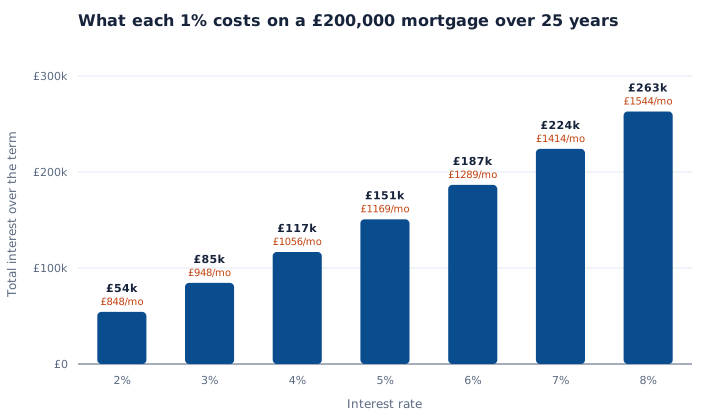
Take a 250,000 pound repayment mortgage over 25 years. The rates below are illustrative assumptions used to show the mechanics, not current market rates.
At an assumed 4.5% fixed, the monthly payment is roughly 1,390 pounds, and it stays there for the whole deal.
At an assumed tracker rate of 4.25%, the payment starts around 1,355 pounds. If base rate rose by one percentage point, taking the tracker to 5.25%, the payment would rise to roughly 1,497 pounds. That is about 142 pounds a month more, or over 1,700 pounds across a year.
The useful question is not which number is smaller today. It is whether you could absorb the higher figure comfortably if it happened, and how much you would mind paying roughly 35 pounds a month for certainty if rates never moved at all.
Who each option tends to suit
Fixed rates suit first time buyers stretching to afford a property, anyone on a tight monthly budget, and households who value a predictable number over a possible saving. Trackers suit people with financial headroom, those expecting to repay early or move soon, and anyone who wants an exit without a penalty. Discounts suit borrowers who understand they are trusting the lender's SVR policy rather than a contractual link to base rate.
Whichever you pick, compare the total cost over the deal period including the product fee, not just the headline rate. A 999 pound arrangement fee added to the loan is not free. You pay interest on it for the rest of the term.
You can use the MortgageMatch directory to find an FCA-authorised broker who will run those total cost comparisons across lenders before you commit to a rate type.
Frequently asked questions
- Is a fixed or variable mortgage better in the UK right now?
- Neither is universally better. A fixed rate suits you if your budget has little slack and you want a payment that cannot change. A variable rate suits you if you have headroom to absorb rises, want the chance of falling payments, or need an exit without an early repayment charge. The decision depends on your circumstances, not on predicting the Bank of England.
- What happens when my fixed rate mortgage ends?
- If you do nothing, you move automatically onto your lender's standard variable rate, which is usually the most expensive rate they offer. You can avoid that by taking a new deal with your existing lender, known as a product transfer, or remortgaging to a different lender. Start looking three to six months before the end date, as offers are typically valid for months.
- Can I switch from a variable rate to a fixed rate mortgage?
- Usually yes. If your variable deal has no early repayment charge you can switch at any time without penalty, either to a new product with the same lender or by remortgaging elsewhere. If your variable deal does carry an early repayment charge, you would need to pay it or wait until the deal period ends. Check your offer document for the exact terms.
- Should I choose a 2 year or 5 year fixed mortgage?
- Choose based on how likely your circumstances are to change. Two years gives you an earlier chance to re-price, which helps if you expect to move, your income is rising, or your loan to value is about to drop into a cheaper band. Five years gives you a longer stretch of stable payments and fewer remortgage rounds, but ties you in for longer.
- How does a tracker mortgage work?
- A tracker charges the Bank of England base rate plus a fixed margin set by the lender. If base rate is 4% and the margin is 0.75%, you pay 4.75%, and your rate changes whenever base rate does, usually from the following month. The margin itself cannot change during the deal period. Some trackers have a floor below which the rate will not fall.
This guide is general information about how UK mortgages work, not a personal recommendation. Only an FCA-authorised adviser can recommend a product for your circumstances. Tax and scheme rules change, so check the relevant government source before you budget.
Related guides
- LTV explained: how loan-to-value affects your mortgage rateWhat loan-to-value means, why lenders price it in bands at 60, 75, 80, 85, 90 and 95 per cent, and how overpayments, house price movement and downvaluations change the band you land in.
- Interest-only mortgages: who they suitHow interest-only mortgages work in the UK, the repayment vehicles lenders accept, typical income and equity requirements, part-and-part options, and what to do if an interest-only mortgage is maturing.
- How to choose a mortgage broker or adviser you can trustHow to check a UK mortgage broker on the FCA Register, tell whole-of-market from panel and tied advisers, ask the right questions, and spot the warning signs before you hand over any money.