5 min read · Updated
How much money do you need to get a mortgage in the UK?
A full cash budget for buying a home: deposit, valuation and survey, conveyancing, searches, property tax, removals and a buffer, with a worked total for a 250,000 pound purchase.
Written and reviewed by the MortgageMatch editorial team. How we research and review our guides.
To buy a 250,000 pound home in the UK you realistically need your deposit plus around 2,500 to 4,500 pounds of other cash. With a 10% deposit that is roughly 27,500 to 29,500 pounds in total, and with a 5% deposit roughly 15,000 to 17,000 pounds. The extras are conveyancing, searches, a survey, mortgage fees, removals and a contingency. First-time buyers in England often pay no property tax at this price under first-time buyer relief, but the rules differ across the UK and change with policy.
The deposit is the biggest number, but not the only one
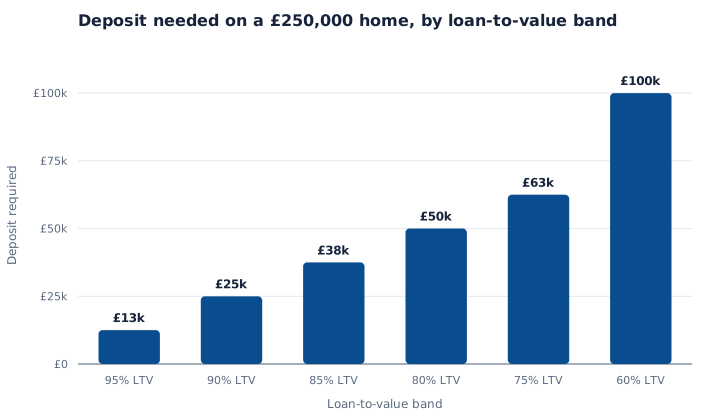
On a 250,000 pound purchase:
- 5% deposit: 12,500 pounds.
- 10% deposit: 25,000 pounds.
- 15% deposit: 37,500 pounds.
- 25% deposit: 62,500 pounds.
Do not put every last pound into the deposit. A completion where you have nothing left is a stressful place to start home ownership, because the first month typically brings a boiler service, a locksmith, curtains and a washing machine.
Conveyancing and searches
Your conveyancer handles the legal transfer, the searches and the property tax return. For a straightforward freehold purchase, budget 1,100 to 1,800 pounds including VAT for the legal fee itself. Leasehold adds work and usually 200 to 400 pounds more, because there is a lease to review and a management pack to obtain from the freeholder, which itself often costs 200 to 500 pounds.
On top sit the disbursements, which are third-party costs your conveyancer pays on your behalf:
- Local authority search: 100 to 350 pounds, varying enormously by council.
- Drainage and water search: 50 to 100 pounds.
- Environmental search: 40 to 100 pounds.
- Land Registry fee: banded by price, commonly 100 to 300 pounds for a typical purchase.
- Bankruptcy and priority searches: a few pounds each.
- Bank transfer fee: 20 to 50 pounds.
- Anti money laundering checks: 10 to 30 pounds per person.
A realistic all-in conveyancing figure for a 250,000 pound freehold house is 1,500 to 2,300 pounds. Get a written quote that separates fees from disbursements, because headline prices online often exclude the disbursements entirely.
Valuation and survey
The lender's valuation confirms the property is adequate security. Many lenders include it free on their products, though some charge 200 to 400 pounds. It is not a survey and you do not usually see much of it.
Your own survey is optional and, on anything but a new build, usually worth it.
- Condition report, the most basic: roughly 300 to 500 pounds.
- Homebuyer report, suitable for most conventional houses in reasonable condition: roughly 400 to 900 pounds.
- Full building survey, for older, larger, listed or heavily altered properties: roughly 700 to 1,500 pounds.
If a survey finds a 4,000 pound roof problem you did not know about, it has paid for itself many times over, either as a price reduction or as a reason to walk away.
Mortgage fees
Products often carry an arrangement or product fee of anywhere between zero and around 1,500 pounds. You can usually add it to the loan, but doing so means paying interest on it for the whole term, so pay it up front if you can.
There may also be a booking fee of 100 to 250 pounds on some products, and a mortgage account or funds transfer fee of around 25 to 50 pounds charged at completion.
Broker fees vary. Many brokers charge nothing to the customer and are paid a procuration fee by the lender. Others charge 300 to 600 pounds, sometimes more for complex cases. Ask about this at the first conversation and get it in writing.
Property tax, and getting the right one
This is where the four nations diverge and where a lot of online advice is simply wrong.
In England and Northern Ireland you pay Stamp Duty Land Tax (SDLT). There is a first-time buyer relief that removes or reduces the charge below a set threshold, with the relief itself withdrawn above a higher purchase price. In Scotland you pay Land and Buildings Transaction Tax (LBTT), administered by Revenue Scotland, which has its own bands and its own first-time buyer relief. In Wales you pay Land Transaction Tax (LTT), administered by the Welsh Revenue Authority, which has a different structure again and does not operate a separate first-time buyer relief in the same way, relying instead on its starting threshold.
All of these thresholds change with government policy, sometimes at short notice in a Budget. Do not rely on a figure you read in an article. Check the current rates on GOV.UK, Revenue Scotland or the Welsh Revenue Authority, and ask your conveyancer to confirm your exact liability before you exchange.
Moving in
- Removals: 400 to 1,200 pounds for a two or three bedroom home, depending on distance and whether you pay for packing. A self-drive van and willing friends can bring this under 150 pounds.
- Buildings insurance: required from exchange, typically 150 to 400 pounds a year. Contents insurance is separate.
- Utility connection, broadband installation and a TV licence: 100 to 300 pounds.
- Immediate essentials: white goods, curtains, a bed, paint. It is very easy to spend 2,000 pounds here and very possible to spend 300.
The worked total for a 250,000 pound purchase
A first-time buyer with a 10% deposit, buying a freehold house in England, no property tax due under first-time buyer relief:
- Deposit: 25,000 pounds.
- Conveyancing including disbursements: 1,800 pounds.
- Homebuyer survey: 600 pounds.
- Mortgage product fee paid up front: 999 pounds.
- Removals: 600 pounds.
- Buildings insurance first premium: 250 pounds.
- Moving-in essentials and contingency: 1,000 pounds.
Total: 30,249 pounds, of which 5,249 pounds is not deposit.
The same buyer with a 5% deposit needs 12,500 pounds plus the same 5,249 pounds, so around 17,750 pounds. And if the purchase were a leasehold flat, add roughly 600 pounds for the extra legal work and management pack.
The buffer nobody budgets for
Keep at least 1,500 to 2,000 pounds untouched after completion. In the first year, a boiler repair, a leaking washing machine, an unexpected service charge demand or a car problem will find you. Buyers who complete with nothing left are the ones who end up on a credit card at a bad rate within months.
If money is tight, the cheapest corners to cut are removals and moving-in spending. The most expensive corner to cut is the survey.
Costs move around a lot by region, by lender and by property type, so treat these as planning figures rather than quotes. A broker will give you an accurate product fee and valuation position for your case, and the MortgageMatch directory is a straightforward way to find an FCA-authorised one to check your numbers against.
Frequently asked questions
- How much money do you need to buy a house in the UK?
- Budget your deposit plus roughly 2,500 to 4,500 pounds of other cash on a typical 250,000 pound purchase. That covers conveyancing and searches, a survey, mortgage fees, removals and insurance. A 10% deposit buyer needs around 30,000 pounds in total and a 5% deposit buyer around 17,500 pounds, before any property tax that may be due.
- How much are solicitor fees when buying a house?
- For a straightforward freehold purchase, expect 1,100 to 1,800 pounds including VAT for the legal work, plus 400 to 700 pounds of disbursements such as local authority, water and environmental searches and the Land Registry fee. Leasehold typically adds 200 to 400 pounds of fees plus a management pack from the freeholder costing 200 to 500 pounds.
- Do first-time buyers pay stamp duty?
- In England and Northern Ireland, first-time buyer relief removes or reduces Stamp Duty Land Tax below a set threshold and is withdrawn above a higher purchase price. Scotland charges Land and Buildings Transaction Tax with its own first-time buyer relief, and Wales charges Land Transaction Tax under a different structure. Thresholds change with policy, so check the relevant government site.
- Is a house survey worth the money?
- On anything other than a new build, usually yes. A homebuyer report costs roughly 400 to 900 pounds and a full building survey 700 to 1,500 pounds. The lender's own valuation only confirms the property is adequate security and tells you nothing useful about condition. Findings frequently support a price reduction worth several times the survey fee.
- Should I pay the mortgage product fee up front or add it to the loan?
- Pay it up front if you can afford to. Adding a 999 pound fee to a 25 year mortgage means paying interest on it for the whole term, which can more than double its real cost. Adding it makes sense only when paying it would leave you without a cash buffer after completion, which is a worse position to be in.
- How much should I keep in savings after buying a house?
- Keep at least 1,500 to 2,000 pounds untouched after completion, and more if the property is older or the survey flagged anything. Boiler repairs, appliance failures and unexpected service charge demands cluster in the first year of ownership. Completing with an empty account is the most common reason new homeowners end up borrowing on expensive short-term credit.
This guide is general information about how UK mortgages work, not a personal recommendation. Only an FCA-authorised adviser can recommend a product for your circumstances. Tax and scheme rules change, so check the relevant government source before you budget.
Related guides
- Offset mortgages explained: when linking savings can helpHow offset mortgages work, the choice between reducing your payment and reducing your term, why the tax treatment beats a savings account for many people, and who actually benefits.
- How much mortgage can I actually afford in the UK?Why income multiples are only the starting point, what counts as income, how commitments and dependants cut the figure, how stress testing works, and a full worked example with two salaries and a car loan.
- Professional mortgages: how lenders assess doctors and other professionalsWhy some lenders offer higher income multiples to doctors, dentists, vets, lawyers and accountants, how NHS banding, locum, bank and private work is treated, and what happens if you are still in training.