6 min read · Updated
How much mortgage can I actually afford in the UK?
Why income multiples are only the starting point, what counts as income, how commitments and dependants cut the figure, how stress testing works, and a full worked example with two salaries and a car loan.
Written and reviewed by the MortgageMatch editorial team. How we research and review our guides.
Most UK lenders will consider lending somewhere around 4 to 4.5 times your annual income, and some go to 5 or 5.5 times for higher earners or specific schemes. That multiple is only a cap. The number you actually get comes from an affordability model that deducts your credit commitments, childcare, dependants and committed expenditure from your income, then tests whether the remainder covers the payment at a stressed interest rate. For most households with debts or children, the affordability model bites long before the multiple does.
The income multiple is a ceiling, not an offer
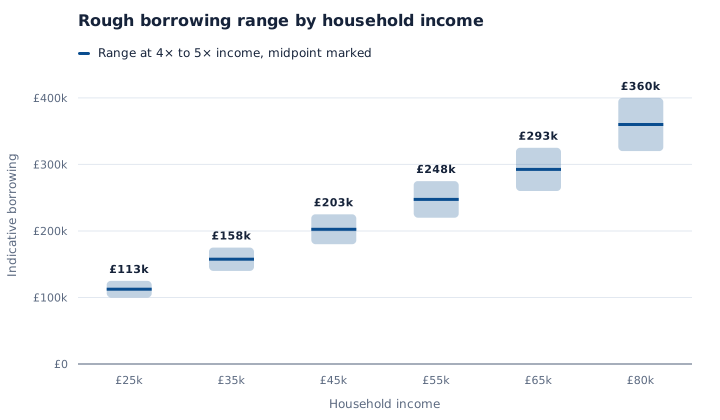
Lenders apply a loan to income cap as a backstop. Typical caps sit around 4.5 times income for most applicants, with higher multiples available in specific cases, often for higher earners, certain professions such as medicine or law, or where the loan to value is low. There are also regulatory limits on how much of a lender's book can sit above 4.5 times income, which is why higher multiples are rationed rather than freely available.
So a couple earning 40,000 and 30,000 pounds might see a headline figure of around 315,000 pounds at 4.5 times joint income. Treat that as the maximum theoretically on the table, then start subtracting.
What counts as income, and how much of it counts
Basic salary is taken in full. Everything else varies by lender, which is a large part of why two lenders can produce very different figures for the same person.
- Overtime, bonus and commission. Commonly taken at 50 per cent, sometimes 100 per cent if it is regular and evidenced, sometimes averaged over two or three years. Guaranteed bonus is usually treated better than discretionary.
- Second job income. Often accepted with a track record, typically 6 to 12 months.
- Self-employed profit. Usually an average of the last two years, though some lenders use the latest year if it is lower, and some use the latest year if it is higher. Sole traders are assessed on net profit, company directors usually on salary plus dividends, though some lenders use salary plus share of retained profit, which can produce a much larger figure.
- Contractor income. Many lenders will annualise a day rate, often as day rate times five days times 46 or 48 weeks.
- Benefits. Child Benefit, tax credits, Universal Credit elements, Disability Living Allowance and Personal Independence Payment are accepted by some lenders, in full or in part, and ignored entirely by others.
- Rental income, maintenance payments and pension income. All accepted by some lenders with evidence.
If a meaningful part of your income is not basic salary, the choice of lender can change your borrowing figure by tens of thousands of pounds. That is the clearest case for using a broker.
What comes off, and how hard it bites
The affordability model deducts your committed expenditure, then applies an estimate of essential household spending, usually based on Office for National Statistics data adjusted for household size, or on the figures you declare, whichever is higher.
The heaviest deductions are usually credit commitments and childcare.
Credit commitments are typically counted at the actual monthly payment for loans and car finance, and at a percentage of the outstanding balance for credit cards and overdrafts, often 3 to 5 per cent. A 6,000 pound credit card balance can therefore be treated as a 180 to 300 pound monthly commitment even if you pay it off in full each month. Some lenders ignore cards cleared monthly, some do not.
Childcare is deducted at what you actually pay, and it is often the single largest line for young families. Dependants also reduce the figure through the household expenditure model, typically by a few hundred pounds a month each.
Other deductions include student loan repayments, pension contributions in some models, maintenance or child support paid, and season ticket loans.
Stress testing
Lenders do not test affordability at the rate you will pay. They test it at a higher rate, to check the payment would still be affordable if rates rose.
Since 2022 the FCA has removed the specific rule in MCOB that required lenders to test against a rate three percentage points above their reversion rate. Lenders still run their own affordability stress tests. The rate they use is a matter of individual lender policy, it differs between lenders, and it moves with the market, so there is no single fixed stress rate to quote. Longer fixed rates of five years or more are often stress tested less severely, which is one reason a five year fix can allow a larger loan than a two year fix on identical income.
A worked example
Take a couple, both employed.
- Person A: 42,000 pounds basic salary, plus a 4,000 pound annual bonus.
- Person B: 31,000 pounds basic salary.
- One child, in nursery three days a week at 620 pounds a month.
- A car loan with 268 pounds a month and 26 months remaining.
- A credit card balance of 3,400 pounds, cleared in full each month.
- Deposit of 45,000 pounds.
Start with the multiple. If the lender takes the bonus at 50 per cent, assessed income is 42,000 plus 2,000 plus 31,000, which is 75,000 pounds. At 4.5 times that is 337,500 pounds.
Now run affordability. Net monthly income for the household is roughly 4,600 pounds after tax and National Insurance. Deduct childcare at 620 pounds and the car loan at 268 pounds. Deduct the credit card, and here the lender choice matters. A lender that ignores cards cleared monthly deducts nothing. A lender applying 3 per cent of the balance deducts 102 pounds. Deduct estimated essential household expenditure for two adults and a child, which many models put somewhere around 1,300 to 1,600 pounds.
That leaves roughly 2,000 to 2,400 pounds a month as available for the mortgage before stress testing. The lender then checks that the payment at its stressed rate fits within that, usually with a buffer.
The plausible outcome is a maximum loan somewhere in the region of 265,000 to 300,000 pounds rather than the 337,500 pounds the multiple suggested. With a 45,000 pound deposit, that is a purchase price of roughly 310,000 to 345,000 pounds.
Now change one thing. Clear the car loan. Removing a 268 pound monthly commitment can commonly add somewhere in the region of 12,000 to 18,000 pounds to the maximum loan, depending on the lender's model. Whether that is a good use of savings depends on whether the deposit reduction costs you a loan to value band, so run both versions before deciding.
What to do with this
Get a decision in principle rather than relying on a calculator. Clear or reduce small credit commitments six months before applying, particularly car finance close to its end. Do not open new credit in the run-up. If your income is complex, get the lender chosen for you rather than choosing it yourself.
And separate what a lender will lend from what you should borrow. The affordability model does not know about your holidays, your car replacement plan or the boiler that is 14 years old.
For a realistic figure based on your actual income mix rather than a generic calculator, the MortgageMatch directory lists FCA-authorised brokers who can run your case across multiple lenders' affordability models.
Frequently asked questions
- How many times my salary can I borrow for a mortgage?
- Most UK lenders cap lending at around 4 to 4.5 times income, with 5 to 5.5 times available in specific cases such as higher earners, certain professions or low loan to value. The multiple is only a ceiling. The actual figure comes from an affordability assessment that deducts credit commitments, childcare and household costs, which usually produces a lower number.
- Do credit cards affect how much mortgage I can get?
- Yes. Many lenders treat a credit card balance as a monthly commitment of around 3 to 5 per cent of the balance, so a 6,000 pound balance can be counted as 180 to 300 pounds a month. Some lenders disregard cards cleared in full each month, others do not. Reducing balances several months before applying usually increases your borrowing figure.
- What income do mortgage lenders accept?
- Basic salary is taken in full. Overtime, bonus and commission are often taken at 50 per cent or averaged over two or three years. Self-employed applicants are usually assessed on two years of profit or salary plus dividends. Benefits, rental income, pension income and maintenance are accepted by some lenders and ignored by others, which is why lender choice matters.
- How do lenders stress test a mortgage?
- They check the payment would still be affordable at a rate higher than the one you will actually pay. Since 2022 the FCA no longer requires the specific three percentage point test that used to be in MCOB, but lenders still apply their own stress tests. The rate used varies by lender and moves with the market, and longer fixed rates are often stressed less severely.
- Does paying off a car loan increase my mortgage affordability?
- Usually yes. Clearing a 268 pound monthly car finance commitment can commonly add somewhere in the region of 12,000 to 18,000 pounds to the maximum loan, depending on the lender's model. The trade-off is that using savings reduces your deposit, which may push you into a worse loan to value band, so compare both scenarios before paying it off.
- Do children reduce how much mortgage I can borrow?
- Yes. Dependants increase the household expenditure figure in a lender's affordability model, typically by a few hundred pounds a month each, and actual childcare costs are deducted on top. For families paying nursery fees, childcare is often the single largest deduction and can reduce the maximum loan by a substantial amount compared with the headline income multiple.
This guide is general information about how UK mortgages work, not a personal recommendation. Only an FCA-authorised adviser can recommend a product for your circumstances. Tax and scheme rules change, so check the relevant government source before you budget.
Related guides
- How much money do you need to get a mortgage in the UK?A full cash budget for buying a home: deposit, valuation and survey, conveyancing, searches, property tax, removals and a buffer, with a worked total for a 250,000 pound purchase.
- Offset mortgages explained: when linking savings can helpHow offset mortgages work, the choice between reducing your payment and reducing your term, why the tax treatment beats a savings account for many people, and who actually benefits.
- Professional mortgages: how lenders assess doctors and other professionalsWhy some lenders offer higher income multiples to doctors, dentists, vets, lawyers and accountants, how NHS banding, locum, bank and private work is treated, and what happens if you are still in training.