5 min read · Updated
Interest-only mortgages: who they suit
How interest-only mortgages work in the UK, the repayment vehicles lenders accept, typical income and equity requirements, part-and-part options, and what to do if an interest-only mortgage is maturing.
Written and reviewed by the MortgageMatch editorial team. How we research and review our guides.
On an interest-only mortgage you pay the lender only the interest each month, so the balance you owe stays the same for the whole term. At the end you have to repay the original loan in full, in one go. That makes the monthly payment much lower than a repayment mortgage, but it does not make the mortgage cheaper. You pay more interest overall, and you need a credible plan for clearing the capital.
How the payment differs
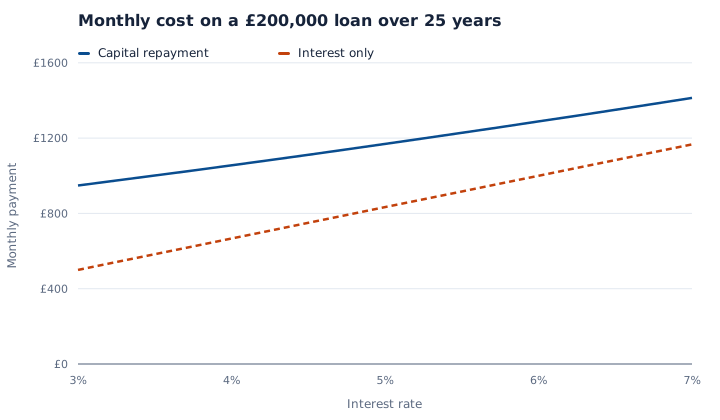
The gap is stark. Take a 200,000 pound mortgage over 25 years at an assumed rate of 5%, used here purely as an illustration rather than a current market rate.
On a repayment basis the monthly payment is roughly 1,169 pounds, and the balance falls to zero by the end.
On interest-only the payment is about 833 pounds, a saving of roughly 336 pounds a month. But after 25 years you still owe the full 200,000 pounds.
Total interest tells the real story. The repayment mortgage costs around 150,000 pounds in interest across the term. The interest-only version costs about 250,000 pounds, because you never reduce the balance the interest is charged on. You have paid 100,000 pounds more and you still owe the original loan.
That is not an argument against interest-only. It is an argument for being clear about what you are buying: cash flow now, in exchange for a lump sum obligation later and a higher total cost.
Repayment vehicles lenders will accept
Since the mortgage market review, lenders must be satisfied you have a credible and plausible way of repaying the capital. Vague intentions do not pass. What is accepted varies by lender, but the common categories are:
- Sale of the mortgaged property, usually only where there is substantial equity and often with a minimum equity requirement expressed in pounds as well as a maximum LTV.
- Sale of another property, with evidence of ownership and equity.
- Cash savings and investments, such as ISAs, unit trusts, shares or a general investment account, usually with an assumed modest growth rate and a requirement to see current statements.
- Pension lump sum, typically the tax-free element, where the term ends after you can access the pension and the projected fund supports it.
- Endowment policies, still relevant for older borrowers, evidenced by the latest projection.
Lenders usually apply a haircut. If your plan relies on investments, they may only credit a proportion of the projected value, and they may set a minimum amount that must be covered by the vehicle rather than by property sale. They also review the plan periodically during the term, not just at the start.
If the plan is a bonus you expect to receive, an inheritance you anticipate, or a business you hope to sell, expect that to be difficult. Some specialist and private lenders will consider it with strong evidence, but it is not mainstream.
Typical requirements
Criteria differ between lenders and change over time, so treat these as the shape of the market rather than a rulebook.
Maximum LTV is usually much lower than on a repayment mortgage. Where a repayment mortgage might go to 90 or 95 per cent, interest-only is more commonly capped somewhere in the 50 to 75 per cent range, and lower still where the repayment strategy is sale of the property.
Minimum income requirements are common, often set at a level well above the average, and sometimes higher for joint applications. Some lenders also set a minimum property value or a minimum equity figure that must remain after the loan is repaid, so that selling the property genuinely leaves you somewhere to live.
Affordability is still assessed. The FCA removed the specific stress test rule from its rules in 2022, but lenders continue to apply their own stress tests, and many assess an interest-only mortgage on a repayment basis anyway to check you could cope if the strategy failed.
Buy to let is the notable exception to all of this. Interest-only is the norm there, assessed primarily on rental income rather than personal income, and it works differently from residential lending.
Part-and-part
Part-and-part splits the loan, with some on repayment and some on interest-only. It is often the sensible middle ground and lenders are frequently more flexible about it than about full interest-only.
Say you need 240,000 pounds. Putting 160,000 on repayment and 80,000 on interest-only reduces your monthly payment compared with full repayment, while guaranteeing that two thirds of the debt clears itself. You only need a repayment plan for the 80,000 pounds. It is a smaller, more believable problem, and if your investments underperform the shortfall is smaller too.
This structure suits people whose income is genuinely lumpy: the self-employed, those on significant bonuses or commission, and anyone whose earnings are expected to rise substantially.
The maturing interest-only problem
A large number of interest-only mortgages sold in the 1990s and 2000s are reaching the end of their terms, and some borrowers arrive there without enough to repay. If that is you, the worst thing you can do is wait for the lender's final letter.
Options that are commonly available, depending on your age, income, equity and lender:
- Extend the term. If you have the income to support it, some lenders will extend, which buys time to build the repayment fund.
- Switch part or all to repayment. The payment rises, but the debt starts falling. Doing this even five years before maturity makes a real difference.
- Remortgage to a lender with more flexible interest-only criteria, including those that lend into retirement.
- Retirement interest-only, where the loan runs until you die or move into long term care and is repaid from the property then, subject to affordability from your pension income.
- Later life products such as lifetime mortgages, which have significant implications for what you leave behind and should only be considered with specialist advice.
- Sell and downsize, which is often the plan that was assumed all along, though it is worth testing whether it really works in your area.
Lenders are generally required to treat customers fairly and to work with you, and engaging early gives you more options than engaging late. If the term ends and the balance is unpaid, the lender can seek possession, so this is not something to leave.
Who interest-only genuinely suits
It works well for borrowers with substantial equity and a real, evidenced repayment vehicle. It works for people with high but irregular income who want a low committed monthly payment and make large ad hoc capital reductions. It works for landlords, where the tax and cash flow logic is different. And it can work as part of a part-and-part structure for households who want flexibility without gambling on the whole debt.
It does not work if the only plan is optimism, or if it is being used to buy a property you could not otherwise afford.
Because interest-only criteria vary so widely between lenders, the MortgageMatch directory is a useful place to find an FCA-authorised broker who knows which lenders will accept your particular repayment strategy.
Frequently asked questions
- Can you still get an interest-only mortgage in the UK?
- Yes, but the criteria are tighter than they were before 2014. Lenders must be satisfied you have a credible plan to repay the capital, and they typically require lower loan-to-value, higher income, and evidence of the repayment vehicle. Availability and requirements vary considerably between lenders, and buy-to-let mortgages are commonly interest-only under a different assessment.
- What repayment vehicles do lenders accept for interest-only?
- Commonly accepted plans include sale of the mortgaged property where there is substantial equity, sale of another property, ISAs and investments, endowment policies, and a pension tax-free lump sum. Lenders usually want current statements or projections and often discount the projected value. Expected bonuses, anticipated inheritances and hoped-for business sales are much harder to get accepted.
- What happens if I cannot repay my interest-only mortgage at the end of the term?
- Contact your lender well before the term ends, because early engagement gives you more options. Depending on your circumstances you may be able to extend the term, switch part or all of the balance to repayment, remortgage to a lender with more flexible criteria, use a retirement interest-only product, or sell the property. If the term ends unpaid, the lender can seek possession.
- Is interest-only cheaper than a repayment mortgage?
- The monthly payment is lower, but the total cost is higher. Because the balance never reduces, you pay interest on the full amount for the whole term. On a 200,000 pound loan over 25 years at an assumed 5 per cent, the interest-only route costs roughly 100,000 pounds more in interest, and you still owe the original 200,000 at the end.
- What is a part-and-part mortgage?
- It splits the loan so that part is on repayment and part is interest-only. The monthly payment sits between the two, a guaranteed portion of the debt clears itself over the term, and you only need a repayment plan for the interest-only slice. Lenders are often more flexible about part-and-part than about a fully interest-only arrangement.
This guide is general information about how UK mortgages work, not a personal recommendation. Only an FCA-authorised adviser can recommend a product for your circumstances. Tax and scheme rules change, so check the relevant government source before you budget.
Related guides
- Fixed vs variable rate mortgagesHow fixed, tracker, discount and capped mortgages work in the UK, what 2, 5 and 10 year fixes really trade off, and how early repayment charges and portability affect the choice.
- LTV explained: how loan-to-value affects your mortgage rateWhat loan-to-value means, why lenders price it in bands at 60, 75, 80, 85, 90 and 95 per cent, and how overpayments, house price movement and downvaluations change the band you land in.
- How to choose a mortgage broker or adviser you can trustHow to check a UK mortgage broker on the FCA Register, tell whole-of-market from panel and tied advisers, ask the right questions, and spot the warning signs before you hand over any money.