How much can I borrow?
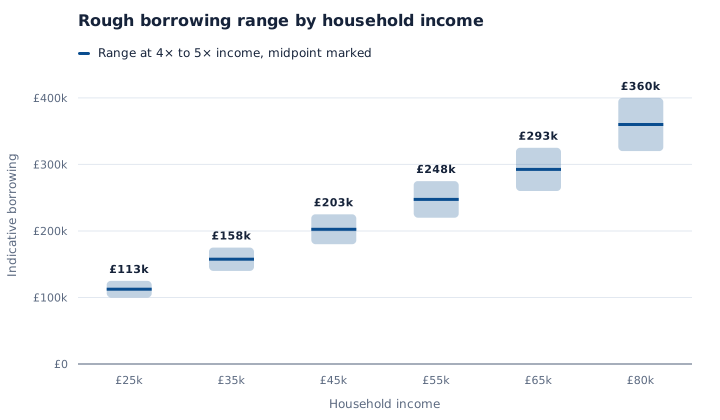
Most UK lenders start from between 4 and 5 times your combined gross annual income, then reduce that for existing credit commitments. This tool gives you that starting figure. Below it, we explain what lenders do next — because the stress test is what usually decides your real number.
Typical borrowing estimate
£202,500
Around 4.5x income after debt commitments
Cautious lender (4x)
£180,000
Generous lender (5x)
£225,000
How the affordability calculation works
The tool uses the income-multiple model that lenders use as their first sift. It does three things:
- Adds your gross annual income to your partner's, if you are applying together.
- Annualises your monthly credit commitments (multiply by 12) and takes that off the income figure, because a lender will not lend against income that is already spoken for.
- Multiplies what is left by 4, 4.5 and 5 to give a cautious, typical and generous view of what different lenders might offer.
Gross means before tax and National Insurance. Lenders work from gross income because tax varies by circumstance, and their own models convert it to a net figure internally.
Why there are three numbers, not one
There is no single UK borrowing multiple. Individual lenders set their own, and the spread between the tightest and the most generous on identical circumstances is routinely £40,000 or more. Showing a range is honest; showing one number would not be.
A worked example, step by step
Worked example
A couple earning £45,000 and £28,000, with £250 a month of car finance
- Combine the incomes: £45,000 + £28,000 = £73,000 gross.
- Annualise the debt: £250 × 12 = £3,000 a year already committed.
- Income the lender will lend against: £73,000 − £3,000 = £70,000.
- Apply the multiples: £70,000 × 4 = £280,000, × 4.5 = £315,000, × 5 = £350,000.
Typical borrowing estimate: £315,000
With a £40,000 deposit, that points to a property around £355,000 and a loan-to-value of roughly 89% — which sits in a more expensive rate band and may itself pull the affordable amount down. Clearing the car finance before applying would add about £13,500 to the borrowing figure at a 4.5 times multiple.
| Monthly commitment | Income lent against | At 4.5x |
|---|---|---|
| £0 | £73,000 | £328,500 |
| £250 | £70,000 | £315,000 |
| £500 | £67,000 | £301,500 |
| £750 | £64,000 | £288,000 |
The stress test: why your real figure is usually lower
An income multiple is a cap, not a decision. Once you pass it, the lender runs an affordability assessment, and the part that catches most people out is the interest rate stress test.
Regulated UK lenders must consider whether you could still afford the mortgage if interest rates rose during the term. So rather than testing your budget against the rate you are being offered, the lender recalculates the payment at a materially higher rate — usually built from the product's reversion rate plus a margin — and checks that the larger payment still leaves you with enough. If it does not, the loan is cut back until it does.
Last checked August 2026. We do not publish a specific stress rate here because each lender sets its own and they move with the market. Ask the lender or your broker what stress rate they are applying to your case — it is a fair question and they will tell you.
Alongside the stress test, the lender applies an expenditure model. Some of it comes from your bank statements and credit file, and some from national statistical averages for a household of your size. Dependants, childcare, commuting, pension contributions, student loan deductions and any maintenance payments all feed in.
What the result does and does not tell you
- It is a loan figure, not a property budget. Add your deposit to get the purchase price you can reach, then take off stamp duty, legal fees, survey and moving costs, which come out of the deposit rather than the loan.
- It is not an Agreement in Principle. An AIP is an actual lender's indication based on a credit check. This is arithmetic.
- Variable income is treated far more cautiously than this. Bonus, commission and overtime are often counted at 50% or averaged over several years, and some lenders exclude them entirely.
- Borrowing the maximum is rarely the goal. Passing a stress test is not the same as living comfortably. The number a lender will approve and the number you should take are different questions.
- Term length changes the answer. A longer term lowers the monthly payment, so it can increase the amount that passes affordability — at the cost of a great deal more interest, and lenders will not extend a term beyond your expected retirement without evidence.
When it is worth speaking to a broker
Affordability is the single area where broker knowledge is worth the most, because the variation between lenders is enormous and none of it is published in a form you can easily compare. It is worth advice if you are self-employed or a company director; paid partly in bonus, commission or overtime; on a fixed-term or zero-hours contract; using income from more than one job; buying with a gifted deposit or a family member; near retirement age at the end of the term; or if a lender has already declined you.
Being turned down leaves a footprint on your credit file, so a second and third application made blindly can make things worse. A broker's job is to identify a lender whose criteria already fit your circumstances before an application is submitted.
Frequently asked questions
- How much can I borrow on a £45,000 salary?
- On a £45,000 salary with no other debts, most UK lenders would consider roughly £180,000 to £225,000, centring on about £202,500 at a 4.5 times income multiple. The exact figure depends on your outgoings, credit record, deposit size and whether the lender's affordability model has room to stretch beyond its standard multiple.
- What is a mortgage stress test?
- A stress test checks whether you could still afford your mortgage if interest rates rose. Lenders recalculate your payment at a rate higher than the one you are actually being offered — typically the product's reversion rate plus a margin — and confirm the higher payment still fits your budget. It is why your approved loan is usually smaller than a simple income multiple suggests.
- Do lenders count credit card and car finance payments?
- Yes. Lenders take committed monthly credit commitments straight off the income they will lend against. A £250 car finance payment can reduce your maximum mortgage by around £13,500 at a 4.5 times multiple. Credit cards are usually assessed on a percentage of the outstanding balance, even if you clear the card in full each month.
- Can I borrow more than 4.5 times my income?
- Sometimes. UK lenders are limited in how much of their lending can exceed 4.5 times income, so higher multiples exist but are rationed. They are most often available to higher earners, to specific professions such as doctors and solicitors, and to applicants with large deposits. A broker will know which lenders currently have appetite.
- Does a bigger deposit let me borrow more?
- A bigger deposit does not usually raise the income multiple, but it lowers your loan-to-value, which unlocks cheaper rates. A cheaper rate means a smaller monthly payment, which passes the affordability assessment more comfortably. So a deposit increases the property price you can reach far more than it increases the loan itself.
- How is self-employed income assessed for a mortgage?
- Most lenders average the last two or three years of self-employed income, usually taking net profit for a sole trader or salary plus dividends for a company director. Some will use the latest year alone, and a few will work from retained profit. Because approaches vary widely, the lender you choose matters more than for an employed applicant.
Keep going
These are the tools and guides people most often need next.
- How much mortgage can I afford? — the longer guide to lender affordability assessments.
- Self-employed mortgage guide — how lenders treat accounts, dividends and retained profit.
- Agreement in Principle explained — turning an estimate into something an estate agent accepts.
Guide only. This calculator gives an illustrative estimate and is not regulated mortgage advice or a personal recommendation. Actual figures depend on the lender, product, term, credit profile and your circumstances. Only an FCA-authorised adviser can recommend a product for you. Your home may be repossessed if you do not keep up repayments on your mortgage.
A guide only, and deliberately simplified. Lenders assess affordability using their own stress-tested models and will consider income type, credit history, deposit, dependants, committed expenditure and monthly outgoings. A qualified mortgage broker or adviser can give you a personalised borrowing figure.
Want a real quote?
Browse independent brokers and advisers who specialise in your situation.
Find a mortgage broker