6 min read · Updated
Getting a mortgage when you're self-employed
How lenders assess sole traders, partners and limited company directors, which documents you need, what happens when profit falls, and how to prepare your accounts a year or two ahead.
Written and reviewed by the MortgageMatch editorial team. How we research and review our guides.
Being self-employed does not mean a smaller mortgage, it means a different evidence trail. Most lenders want two years of accounts or SA302 tax calculations with the matching tax year overviews, and some will consider one year. Sole traders are usually assessed on net profit, and limited company directors on salary plus dividends, though certain lenders will use salary plus their share of retained profit instead. The lender you pick matters more than almost anything else.
What counts as self-employed
Most lenders treat you as self-employed if you own 20 to 25 per cent or more of a business, though the exact shareholding threshold varies. That means a minority shareholder in a company can still be assessed as employed, while a director with a quarter of the shares is assessed on business figures even if they draw a regular salary.
You are also usually treated as self-employed if you are a sole trader, a partner in a partnership, or a subcontractor paid gross. If you have a mix, say a part-time employed role plus a side business, most lenders will consider both, but they will want the self-employed part evidenced to the same standard.
Sole traders and partnerships
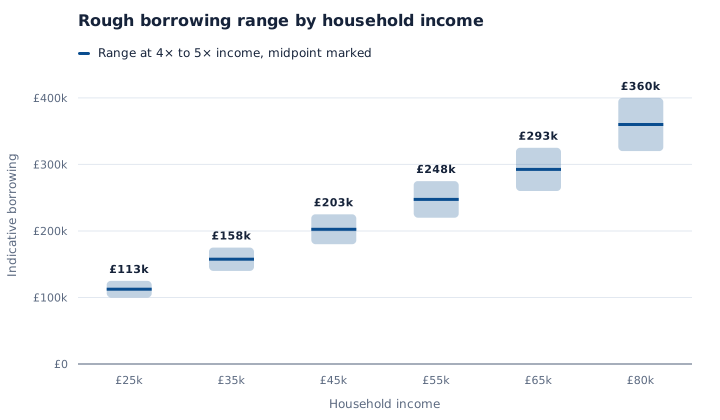
For a sole trader, the assessable income is normally net profit, which is profit after allowable business expenses but before income tax. Turnover is irrelevant to the calculation. Someone invoicing 120,000 a year who nets 48,000 after costs is a 48,000 applicant, not a 120,000 one.
For a partner, the figure is normally your share of the net profit, taken from the partnership accounts or your own tax calculation. If your profit share changed because the partnership agreement changed, be ready to explain it in writing.
A word on expenses. Claiming aggressively reduces your tax bill and reduces your borrowing power at the same time. Heavy capital allowances or a large one-off equipment write-off can knock a year's profit down sharply. Some underwriters will add back genuinely one-off, non-cash items if your accountant explains them, but you cannot count on it.
Limited company directors
The default approach is salary plus dividends. Take the salary you pay yourself, add the dividends you declared, and that is your income. Because many directors pay themselves a small salary and leave money in the company, this default often understates what the business actually earns.
That is where retained profit lenders come in. A smaller group of lenders will assess you on salary plus your share of the company's net profit, usually after corporation tax, whether or not you drew it. If your company is profitable and you have been leaving money in it, this can transform the numbers.
Here is a worked example, with an illustrative income multiple of 4.5 times used purely to show the mechanism. Suppose you are the sole shareholder of a consultancy. Last year you took a salary of 12,570 and dividends of 40,000. The year before you took the same salary and 30,000 of dividends. Company net profit after corporation tax was 85,000 in the latest year.
On the salary plus dividends approach using the latest year, your income is 52,570 and a 4.5 times multiple gives roughly 236,000. On a two year average, income is about 47,570 and the same multiple gives roughly 214,000. On the retained profit approach, income is 12,570 plus 85,000, which is 97,570, and 4.5 times that is roughly 439,000. Same business, same person, roughly double the borrowing depending on which lender reads the file.
Which year do lenders use
Many lenders take the lower of the most recent year or the average of the last two. A few will use the latest year alone when income is rising, which helps a growing business. Some will average all available years, which drags a strong recent year down.
Because of this, one growing business can be assessed at three quite different income figures depending on where the application lands. This is the single strongest argument for taking advice rather than applying to whichever lender advertises the sharpest rate.
The falling profit problem
If your latest year is lower than the year before, expect questions. Most lenders will use the lower figure by default, and a significant drop can lead to a decline even where the lower figure would be affordable on its own, because underwriters read a downward trend as a risk signal.
You can help yourself by getting ahead of it. Write a short, factual explanation of why profit fell and what has happened since. A lost contract that has been replaced, a year of investment in equipment or staff that has since paid off, a period of parental leave or illness, or a deliberate change in how you take income are all explainable. Back it up with current year management accounts, an accountant's letter, and evidence of new work such as signed contracts or a healthy order book.
Where the fall was genuinely one-off and the current year is clearly recovering, some lenders will look at management accounts alongside the filed figures. Not all will, and none are obliged to.
Documents you will need
Have these ready before you approach anyone, because a half-assembled file is the most common cause of delay.
- Two to three years of finalised accounts, prepared or signed off by a qualified accountant
- SA302 tax calculations for the same years, downloaded from HMRC or produced by your accountant's software
- Tax year overviews to match each SA302, showing the tax has been declared and, ideally, paid
- Three to six months of personal bank statements, and business statements if asked
- Latest management accounts if your year end is a long way back
- An accountant's reference or certificate, which lenders often request
- Proof of deposit and its source, plus identity and address documents
The tax year overview matters more than people expect. An SA302 on its own shows what was declared. The overview confirms it reached HMRC. Lenders normally want both, for the same years, and they must match.
Preparing 12 to 24 months ahead
If you can plan the timing, do. File your tax returns promptly rather than at the January deadline, because most lenders will want the latest year once it is filed and some will insist on it if the filing date has passed.
Think about how hard you push expenses in the year before you apply. Reducing your declared profit by 8,000 to save tax might cost you 36,000 of borrowing at a 4.5 times multiple. That is a trade worth doing deliberately rather than by accident.
Keep your personal credit clean. Self-employed applications get read more closely, and a missed credit card payment carries more weight when an underwriter is already scrutinising the file. Avoid opening new credit lines or taking business finance in the three months before you apply, since new commitments reduce affordability.
Finally, keep business and personal money separate. Underwriters dislike files where personal spending runs through a business account, because it makes the profit figure harder to trust.
Because so much depends on which lender reads your accounts and how, this is a case where whole of market advice usually pays for itself. The MortgageMatch directory lists FCA-authorised brokers, including those who work with self-employed applicants and retained profit lenders every week.
Frequently asked questions
- How many years of accounts do I need for a mortgage if I am self-employed?
- Most lenders want two years of accounts or SA302 tax calculations plus the matching tax year overviews. Some will consider one year, particularly where you have a track record in the same line of work as a previous employee, though the choice of lender narrows and the rate may be higher. Three years gives you the widest range of options.
- Can I get a mortgage using retained profit in my limited company?
- Some lenders will assess a director on salary plus their share of company net profit rather than salary plus dividends. This often produces a much higher income figure where you have deliberately left money in the business. Not every lender offers it, criteria vary, and an accountant's reference confirming the profit figure is usually required.
- What happens if my profits went down last year?
- Most lenders take the lower of the latest year or a two year average, so a fall reduces your borrowing and prompts questions. A sharp drop can lead to a decline even where the lower figure is affordable. A written explanation, an accountant's letter and current management accounts showing recovery all help, but nothing guarantees acceptance.
- Are sole traders assessed on turnover or profit?
- Profit, not turnover. Lenders use net profit, which is what is left after allowable business expenses but before income tax. Someone with 120,000 of turnover and 48,000 of net profit is treated as a 48,000 applicant. This is why aggressive expense claiming reduces your borrowing capacity as well as your tax bill.
- Do I need an accountant to get a self-employed mortgage?
- You are not legally required to have one, but in practice it makes the process far easier. Lenders often ask for an accountant's reference or certificate, and many want accounts prepared by someone with a recognised qualification. An accountant can also produce SA302 equivalents and management accounts quickly when an underwriter asks for them mid-application.
This guide is general information about how UK mortgages work, not a personal recommendation. Only an FCA-authorised adviser can recommend a product for your circumstances. Tax and scheme rules change, so check the relevant government source before you budget.
Related guides
- Credit score and mortgages: what lenders actually checkThe three credit reference agencies, why there is no single score lenders share, which entries do the most damage, the fixes that work in three to six months, and how many applications is too many.
- Contractor mortgages: getting approved on a day rateHow lenders annualise a contract day rate, how much contracting history you need, how gaps between contracts are treated, and what changes if you work through an umbrella or inside IR35.
- Getting a mortgage with bad creditWhat counts as adverse credit, how the age and severity of a default, CCJ, IVA or bankruptcy changes your options, what deposit lenders expect, and what the higher rate actually costs.