6 min read · Updated
Stamp duty in 2026: what buyers actually pay
How property purchase tax works across England, Northern Ireland, Scotland and Wales, with banded worked examples, first-time buyer relief, the additional property surcharge and filing deadlines.
Written and reviewed by the MortgageMatch editorial team. How we research and review our guides.
There is no single UK stamp duty. Buyers in England and Northern Ireland pay Stamp Duty Land Tax, buyers in Scotland pay Land and Buildings Transaction Tax, and buyers in Wales pay Land Transaction Tax. All three are charged in slices, so you pay a different percentage on each portion of the price rather than one rate on the whole lot. Rates change at Budgets and other fiscal events, so always confirm current bands before you budget.
Three separate taxes across the UK
The taxes have different names, different thresholds and different reliefs, and they are run by different bodies. Stamp Duty Land Tax (SDLT) in England and Northern Ireland is collected by HMRC. Land and Buildings Transaction Tax (LBTT) in Scotland is collected by Revenue Scotland. Land Transaction Tax (LTT) in Wales is collected by the Welsh Revenue Authority.
What matters is where the property is, not where you live. If you live in Manchester and buy a flat in Edinburgh, you pay LBTT on Scottish rules. Never assume a figure you have read about one regime applies to another. The gap between them at some price points runs into thousands of pounds.
How the banded calculation works
Every one of the three taxes uses a slice system. You take the purchase price, split it across the bands, apply each band's rate to the part of the price that falls inside it, and add the results together.
This matters because of a common misunderstanding. Going one pound over a threshold does not push your entire purchase into a higher rate. Only the slice above the threshold is taxed at the higher rate. The old slab system, where crossing a threshold repriced the whole purchase, was scrapped years ago.
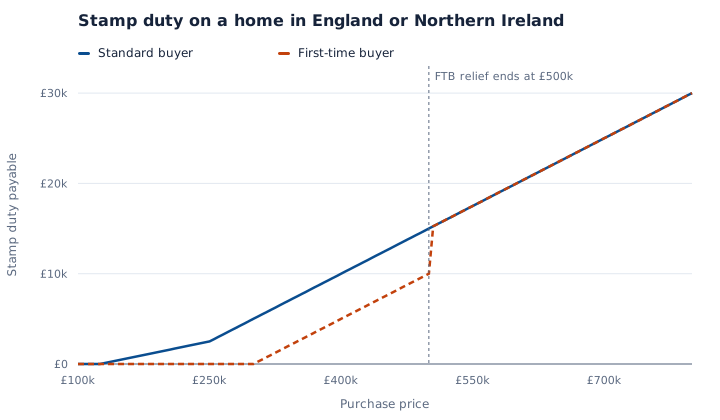
The England and Northern Ireland thresholds that applied from 1 April 2025, and which were still in place when this guide was last checked in August 2026, were as follows for someone buying a single home who already owns no other property. Nothing on the first 125,000. Two per cent on the slice from 125,000 to 250,000. Five per cent from 250,000 to 925,000. Ten per cent from 925,000 to 1.5 million. Twelve per cent on anything above 1.5 million. Check GOV.UK for the current position before you commit to a budget, because these numbers move.
Two worked examples
Take a 300,000 purchase in England by someone who is moving home and will own only that property. The first 125,000 is taxed at nothing. The next 125,000, the slice from 125,000 up to 250,000, is taxed at two per cent, which is 2,500. The final 50,000, the slice from 250,000 to 300,000, is taxed at five per cent, which is another 2,500. The bill is 5,000.
Now take a 600,000 purchase on the same basis. Nothing on the first 125,000. Two per cent on the next 125,000 gives 2,500. Five per cent on the 350,000 that sits between 250,000 and 600,000 gives 17,500. The total is 20,000.
Notice the shape of it. Doubling the price did not double the tax, it quadrupled it, because more of the price sits in the five per cent band. That non-linearity is why buyers stretching their offer by 30,000 or 40,000 sometimes get an unpleasant surprise on the completion statement.
First-time buyer relief
In England and Northern Ireland, first-time buyer relief means no tax on the first 300,000, five per cent on the slice from 300,000 to 500,000, and no relief at all if the price is above 500,000. At 500,001 you fall back to the standard rates on the whole purchase, which is one of the few genuine cliff edges left in the system.
So a first-time buyer paying 300,000 pays nothing where a home mover pays 5,000. A first-time buyer paying 450,000 pays five per cent on 150,000, which is 7,500. A first-time buyer paying 600,000 pays the full 20,000, the same as anyone else.
To qualify, every buyer on the purchase must be a first-time buyer. If you have never owned a home but your partner inherited a share of a property years ago, the relief is usually lost for the whole transaction. That catches people out constantly. Scotland and Wales handle first-time buyers differently, so do not carry these figures across the border.
Surcharges: additional properties and non-UK residents
If you already own a residential property anywhere in the world and you are buying another, an additional dwellings surcharge is normally added on top of every band. When this guide was last checked in August 2026 that surcharge was five percentage points in England and Northern Ireland, but surcharge rates have moved more than once in recent years, so verify it.
On our 300,000 example, a second property would attract the 5,000 of standard tax plus a surcharge on the full price. At five per cent of 300,000 that is another 15,000, giving 20,000 in total. The surcharge often costs more than the underlying tax.
There is normally relief if you are replacing your main residence and there is a short overlap between buying the new one and selling the old one. You usually pay the surcharge up front and reclaim it once the old home sells, within a time limit that has typically been 36 months. Scotland and Wales operate their own versions of the surcharge at their own rates.
Separately, in England and Northern Ireland, buyers who are not UK resident for the purposes of the tax pay a further two per cent on top. The residence test is its own test and is not the same as the one used for income tax, so take advice if you have spent time abroad.
Scotland: Land and Buildings Transaction Tax
LBTT works on the same slice principle but has its own thresholds and its own rates, and its own first-time buyer relief which takes the form of a raised nil rate band rather than the England structure. Scotland also has the Additional Dwelling Supplement for second and subsequent residential properties, charged on the whole price. Revenue Scotland publishes the current bands and a calculator, and that is where you should get your figures rather than from any secondhand source.
Wales: Land Transaction Tax
LTT also uses slices. The important difference to know is that Wales has no first-time buyer relief. Instead the main residential nil rate band starts higher than the England one, which helps buyers at the lower end regardless of whether they have owned before. Wales has its own higher residential rates for additional properties. Check the Welsh Revenue Authority for the bands in force on your completion date.
Filing, paying and common misconceptions
In England and Northern Ireland you must file an SDLT return and pay within 14 days of completion. In Scotland and Wales the deadline has generally been 30 days. In practice your conveyancer files and pays on your behalf out of the funds you send them, but the legal duty is yours, and late filing brings penalties and interest.
Three misconceptions are worth killing off. First, the tax is not part of your mortgage. Lenders will not normally lend you the money to pay it, so it has to come from your own funds on top of the deposit and fees. Second, a nil bill does not always mean no return. Some transactions still require a filing even when nothing is due, and your conveyancer will tell you which. Third, an offer accepted before a rate change does not lock in the old rates. What normally matters is the effective date of the transaction, usually completion, so a delayed purchase across a fiscal event can change the bill.
If your budget is tight enough that the tax bill decides which properties you can bid on, get the mortgage side modelled properly at the same time. You can use the MortgageMatch directory to find an FCA-authorised broker who will run the numbers with the tax and fees included rather than after the fact.
Frequently asked questions
- How much stamp duty do I pay on a 300,000 house?
- On a 300,000 home in England or Northern Ireland bought by someone who will own no other property, the calculation from 1 April 2025 was nothing on the first 125,000, two per cent on the next 125,000 and five per cent on the final 50,000, giving 5,000. A qualifying first-time buyer would pay nothing at that price. Confirm current thresholds on GOV.UK.
- Do first-time buyers pay stamp duty?
- In England and Northern Ireland, first-time buyers paid nothing on the first 300,000 and five per cent from 300,000 to 500,000, with no relief at all above 500,000. Every buyer named on the purchase must be a first-time buyer for the relief to apply. Scotland and Wales use different systems, and Wales has no first-time buyer relief at all.
- Is stamp duty different in Scotland and Wales?
- Yes, and the taxes are not the same tax. Scotland charges Land and Buildings Transaction Tax through Revenue Scotland, and Wales charges Land Transaction Tax through the Welsh Revenue Authority. Both use banded slice calculations like the English system but with their own thresholds, rates and reliefs. The property location decides which applies, not where you live.
- Can I add stamp duty to my mortgage?
- Generally not. Lenders size the loan against the property value and expect purchase tax, legal fees and survey costs to come from your own funds alongside the deposit. Some buyers borrow a slightly smaller deposit contribution elsewhere to cover it, but that affects affordability. Budget for the tax as cash you need on completion day.
- How long do I have to pay stamp duty after completion?
- In England and Northern Ireland the return must be filed and the tax paid within 14 days of completion. Scotland and Wales have generally allowed 30 days. Your conveyancer normally handles the filing and pays from funds you have already transferred, but the legal responsibility sits with you and late payment attracts penalties and interest.
- Do I pay the surcharge if I already own a property abroad?
- Usually yes. The additional dwellings surcharge normally looks at residential property you own anywhere in the world, not just in the UK. Owning even a share of another home can trigger it. If you are replacing your main residence and the sale completes shortly after the purchase, a refund of the surcharge is often available within the published time limit.
This guide is general information about how UK mortgages work, not a personal recommendation. Only an FCA-authorised adviser can recommend a product for your circumstances. Tax and scheme rules change, so check the relevant government source before you budget.
Related guides
- Mortgage application documents: the full checklistEvery document a UK lender is likely to ask for, covering employed, self-employed and contractor income, deposit evidence, identity, gifted deposits, buy to let and new build, plus how to avoid delays.
- Joint mortgages: what to know before you signJoint tenants versus tenants in common, declarations of trust, protecting unequal deposits, how two incomes are assessed, removing someone from a mortgage later, and how JBSP arrangements work.
- Mortgage Agreement in Principle: what it is and how to get oneWhat a mortgage agreement in principle is, what lenders check before issuing one, how to get one in about 15 minutes, and the limits of what it proves.