7 min read · Updated
Joint mortgages: what to know before you sign
Joint tenants versus tenants in common, declarations of trust, protecting unequal deposits, how two incomes are assessed, removing someone from a mortgage later, and how JBSP arrangements work.
Written and reviewed by the MortgageMatch editorial team. How we research and review our guides.
A joint mortgage makes every borrower liable for the whole debt, not a share of it. If one person stops paying, the lender can pursue the other for the full amount. Ownership is a separate question from the mortgage: you can hold the property as joint tenants, where the whole passes automatically to the survivor, or as tenants in common, where each of you owns a defined share you can leave to whoever you choose. Decide both points before you exchange, not afterwards.
Joint and several liability, in plain terms
This is the single most important thing to understand and the one most often skimmed over.
On a joint mortgage you are jointly and severally liable. That means the lender is not interested in your private agreement that one of you pays 60 percent. If payments stop, the lender can chase either of you for the entire outstanding balance. Missed payments appear on both credit files. A repossession affects both of you.
It also creates a financial association on your credit file. Once you are linked to someone, lenders assessing you in future can see and consider their credit record too. That association does not disappear when the relationship does. You have to apply to the credit reference agencies for a notice of disassociation once the financial link has genuinely ended.
Joint tenants versus tenants in common
These describe how you own the property, and your conveyancer will ask which you want.
Joint tenants means you own the whole property together, with no distinct shares. If one of you dies, the property passes automatically to the survivor by right of survivorship, regardless of what a will says. Neither of you can leave your interest to someone else. This suits many married couples and long-term partners who intend everything to pass to each other.
Tenants in common means each of you owns a specified share, which might be equal or might be 70 and 30. On death, your share passes under your will, or under the intestacy rules if you do not have one. This suits unequal deposits, second relationships where you have children from a previous one, friends buying together, and family arrangements.
- Choose joint tenants for simplicity and automatic survivorship.
- Choose tenants in common where shares are unequal, where you want to leave your share to someone specific, or where the parties are not a couple.
- You can convert from joint tenants to tenants in common later by severing the joint tenancy, which is a straightforward legal step.
If you own as tenants in common, write a will. Without one, your share is distributed under the intestacy rules, and an unmarried partner has no automatic entitlement under those rules.
Declarations of trust and unequal deposits
If one of you is putting in a much larger deposit, a declaration of trust, sometimes called a deed of trust, is the document that protects it. It is prepared by a solicitor and records what happens on a sale.
A worked example. You buy at 350,000 pounds. Anna contributes 60,000 pounds of deposit, Ben contributes 10,000 pounds, and you take a 280,000 pound joint mortgage paid equally.
Without a declaration of trust, and holding as joint tenants, the default assumption is a 50 50 split of the proceeds. If you sell three years later for 380,000 pounds and the balance is 260,000 pounds, the 120,000 pounds of equity is split 60,000 pounds each. Anna has effectively given Ben 25,000 pounds.
With a declaration of trust, you can agree that each deposit is returned first and the remaining equity is split equally. Anna gets her 60,000 pounds back, Ben gets his 10,000 pounds, and the remaining 50,000 pounds is split 25,000 pounds each. Anna receives 85,000 pounds and Ben 35,000 pounds.
You can also record other things in it: who pays what proportion of the mortgage, how home improvement spending is credited, what notice period applies if one of you wants to sell, and whether one party has a right to buy the other out first.
Married, unmarried, and why it matters
If you are married or in a civil partnership, the courts have wide powers to redistribute property on divorce or dissolution, and a declaration of trust is one factor rather than the final word.
If you are unmarried, there is no such regime. There is no such thing as a common law spouse in England and Wales, however long you have lived together. Your rights are determined by property law, which means by whose name is on the title and what documents you signed. This is precisely why unmarried couples benefit most from getting the ownership structure right at the outset.
Note also that Scotland has a separate legal system with different terminology and rules, so take Scottish advice if you are buying there.
Affordability with two incomes
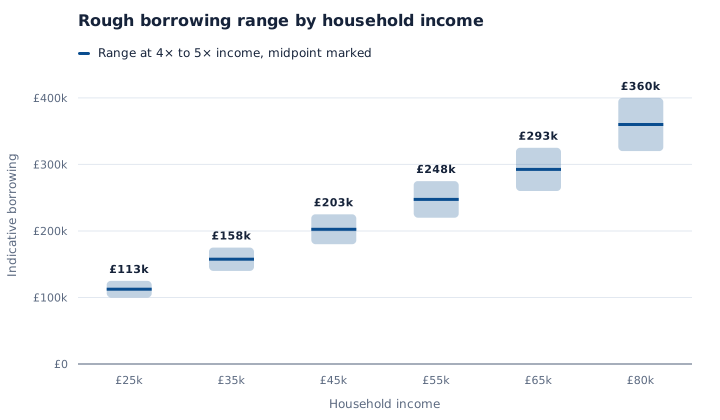
Two incomes usually increase what you can borrow, but not by simply doubling it.
Lenders combine both incomes, then deduct committed outgoings for both of you: credit cards, loans, car finance, childcare, maintenance payments and student loan deductions where relevant. They then stress test the payment against a higher notional rate to check you could still afford it if rates rose.
Two practical points. First, the weaker credit file usually dictates the lender. If one applicant has a recent default, the case has to go to a lender that accepts it, even though the other applicant is spotless. Second, existing debt on either side reduces borrowing capacity for both, so clearing a car finance agreement before applying can be worth more than it looks.
Most lenders allow up to two applicants as standard. Some will consider three or four, though usually only two incomes are used in the calculation.
Removing someone from a joint mortgage later
This is called a transfer of equity. It is not a matter of telling the lender that one of you has moved out.
The process runs roughly like this. The remaining borrower applies to the lender to take on the mortgage alone. The lender reassesses affordability on that single income, and this is where most cases fail, because a mortgage taken on two incomes frequently is not affordable on one. If the lender agrees, a solicitor handles the transfer of the legal title, and any payment to the departing party for their share of the equity is dealt with at the same time. Stamp duty can apply if the person taking over is treated as receiving consideration above the threshold, which usually means taking on more than a certain amount of debt.
Realistic timing is four to twelve weeks. If the current lender says no, the alternative is to remortgage the whole thing with a different lender, or to sell.
Until the transfer completes, the person who moved out remains fully liable. Moving out changes nothing about the mortgage.
Joint borrower sole proprietor
A joint borrower sole proprietor mortgage, usually shortened to JBSP, lets someone support your application with their income without being an owner of the property. It is most often used by parents helping a child buy.
The supporting borrower is named on the mortgage and is fully liable for the payments, but is not on the title deeds. That means they have no ownership share.
The main attraction is stamp duty. Because the supporter does not own a share of the property, the higher rates that apply to additional property purchases are generally not triggered for them in the way they would be on a standard joint purchase. Tax rules change, so confirm the current position before relying on this.
The risks are real for the supporter. They are liable for the whole debt, the mortgage appears on their credit file and affects their own future borrowing, and they have no ownership stake to show for it. Lenders also apply their own rules, commonly around maximum age at the end of the term, which limits how long a parent can support.
- Agree in writing how long the arrangement will last and when the supporter comes off.
- Check the lender allows a later removal without a full remortgage.
- Both parties should consider life cover, because the debt does not disappear if one of you dies.
Practical things to sort before you sign
Protection matters more on a joint mortgage than a sole one, because the survivor inherits the whole liability. Consider life cover at least equal to the mortgage, and think about critical illness and income protection.
Make wills, particularly if you own as tenants in common or are unmarried. Agree the ownership structure and any declaration of trust with your conveyancer before exchange, because changing it afterwards is more expensive and occasionally impossible if one party has changed their mind.
If you want advice on how a joint application will be assessed, the MortgageMatch directory lets you find FCA-authorised brokers who handle joint and JBSP cases.
Frequently asked questions
- What is the difference between joint tenants and tenants in common?
- Joint tenants own the whole property together, and if one dies their interest passes automatically to the survivor regardless of any will. Tenants in common each own a defined share, which can be unequal, and that share passes under their will. Tenants in common suits unequal deposits, friends buying together, and second relationships with children from a previous one.
- What happens if one person stops paying a joint mortgage?
- Joint mortgages carry joint and several liability, so the lender can pursue either borrower for the entire outstanding balance, not just a share. Missed payments are recorded on both credit files and affect both people's future borrowing. Moving out of the property changes nothing until the mortgage is formally transferred, remortgaged or repaid.
- How do you remove someone from a joint mortgage?
- You apply to the lender for a transfer of equity. The remaining borrower is reassessed on their own income, which is where most applications fail because the loan was affordable on two incomes. If approved, a solicitor transfers the legal title and settles any payment for the departing party's equity. It typically takes four to twelve weeks.
- Do I need a declaration of trust if we put in different deposits?
- It is strongly advisable. Without one, proceeds of sale are commonly split according to the ownership structure rather than what each person contributed, so a larger deposit can effectively be shared. A declaration of trust records each contribution, how equity is divided on sale, and can also cover mortgage payment shares and improvement spending.
- What is a joint borrower sole proprietor mortgage?
- A JBSP mortgage lets someone, usually a parent, support an application with their income while not being an owner of the property. They are named on the mortgage and fully liable for repayments but are not on the title deeds. Because they do not own a share, additional property stamp duty rates are generally not triggered for them.
- Can unmarried couples get a joint mortgage in the UK?
- Yes, and lenders assess unmarried applicants in the same way as married ones. The difference is legal rather than financial: there is no common law marriage in England and Wales, so an unmarried partner has no automatic claim on the other's share. Ownership structure, a declaration of trust and up to date wills matter more as a result.
This guide is general information about how UK mortgages work, not a personal recommendation. Only an FCA-authorised adviser can recommend a product for your circumstances. Tax and scheme rules change, so check the relevant government source before you budget.
Related guides
- Mortgage application documents: the full checklistEvery document a UK lender is likely to ask for, covering employed, self-employed and contractor income, deposit evidence, identity, gifted deposits, buy to let and new build, plus how to avoid delays.
- Mortgage Agreement in Principle: what it is and how to get oneWhat a mortgage agreement in principle is, what lenders check before issuing one, how to get one in about 15 minutes, and the limits of what it proves.
- How long does a mortgage agreement in principle last?How long agreements in principle stay valid, how to check your expiry date, what happens if yours lapses mid-purchase, and whether renewing triggers another credit search.