6 min read · Updated
Later life mortgage options
Maximum lending ages, how pension income and drawdown are assessed, how Retirement Interest Only mortgages work, extending a term into retirement, and the joint borrower risk nobody explains.
Written and reviewed by the MortgageMatch editorial team. How we research and review our guides.
If you are over 55 and need a mortgage, you have more choices than you probably think. Standard mortgages are available well into later life where income supports the payments, Retirement Interest Only mortgages let you pay interest indefinitely with no fixed end date, and lifetime mortgages require no payments at all. The constraint is rarely age alone. It is whether the lender believes you can afford the payments for the whole term, using income that will still be there after you stop working.
Two age limits, and only one of them usually bites
Lenders set a maximum age at application and a maximum age at the end of the term. These are different numbers and the second one does the work.
Maximum age at application is often somewhere between 70 and 85, depending on the lender. Maximum age at the end of the term is commonly in the range of 70 to 85 for mainstream lenders, though a number of building societies go to 90 or have no upper limit at all, assessing affordability instead. Some lenders will not lend beyond your stated retirement age unless you can evidence retirement income.
These limits vary widely and change with policy, so treat any specific number you read as indicative. What is consistent is the underlying logic. A lender wants evidence that the payment is affordable across the full term. If part of the term falls after you stop working, it wants evidence of retirement income covering that part.
A worked consequence. You are 62 and want to borrow 150,000 pounds. A lender with a maximum end age of 75 will offer you a maximum 13 year term. On an illustrative 4.5 per cent repayment basis, 150,000 pounds over 13 years costs roughly 1,290 pounds a month. Over 25 years it would be roughly 834 pounds. The short term, not the age itself, is what makes the affordability fail. Finding a lender with a higher end age is often the whole solution.
How lenders assess pension, drawdown and annuity income
Where the term runs past retirement, the lender assesses post-retirement income. How it treats each source varies.
- State pension. Usually accepted in full, evidenced by a state pension forecast from the government's service or an award letter.
- Defined benefit pension in payment. Usually accepted in full and treated as very reliable, evidenced by payslips or an award letter.
- Annuity income. Usually accepted in full, since it is guaranteed for life.
- Pension drawdown already in payment. Often accepted, but treatment varies a lot. Some lenders take the full drawdown amount, some apply a haircut, and some assess sustainability against the size of the remaining pot.
- Uncrystallised pension pot not yet drawn. Frequently the hardest case. Some lenders will apply an assumed drawdown rate to the fund value, often a conservative percentage. Others will not count it at all until it is in payment.
- Investment and rental income. Often accepted with an evidence trail, usually two years of tax returns or accounts.
If you are approaching retirement rather than in it, expect to provide a state pension forecast and pension statements alongside your current payslips. Lenders will typically assess pre-retirement income for the years before your stated retirement date and post-retirement income after it, and the payment must be affordable on both.
Retirement Interest Only mortgages
A RIO sits between a standard mortgage and equity release. You pay the interest monthly, so the capital balance never grows and never reduces. The loan is repaid from the sale of the property when the last borrower dies or moves permanently into long-term care. It generally has no fixed end date other than those events.
The critical difference from a lifetime mortgage is affordability. A RIO requires you to prove you can afford the interest payments from your income, and that assessment normally has to work on a single survivor basis for a joint application. That means the lender asks whether the payment would still be affordable if one of you died and the household lost that person's pension income. Many couples pass on joint income and fail on single income, which is the most common reason RIO applications are declined.
RIOs typically require a lower loan to value than a standard mortgage, often up to around 50 or 60 per cent, though this varies. Uses include repaying an interest only mortgage that is maturing with no repayment vehicle, buying out a former partner in later life, or releasing a modest amount of capital while keeping the debt flat.
Extending your term into retirement
If your current mortgage payment is uncomfortable, extending the term reduces it. Lenders will generally allow this if the new end date sits within their maximum age policy and affordability works on the income that will exist at that point.
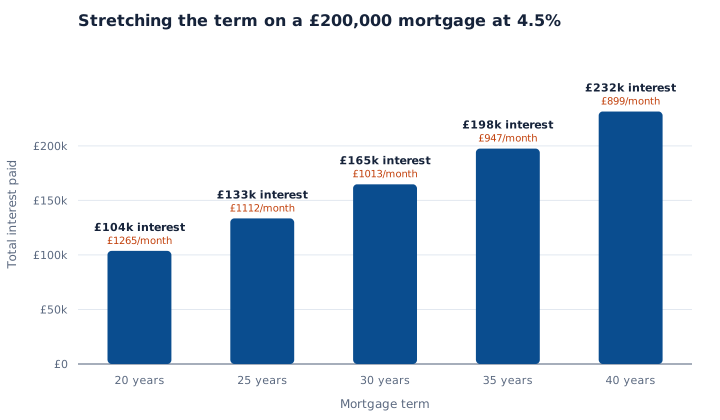
On a 120,000 pound balance at an illustrative 4.5 per cent, extending from 10 years to 18 years cuts the monthly payment from roughly 1,244 pounds to roughly 828 pounds. The total interest paid rises substantially, from around 29,000 pounds to around 59,000 pounds. That is the trade. Lower payments now, more interest overall, and debt carried further into retirement.
A term extension is worth considering when the alternative is payment difficulty. It is less attractive as a way of freeing up money for discretionary spending. You can often reverse the effect later by overpaying, and most mortgages allow overpayments of around 10 per cent of the balance a year without charge.
The joint borrower risk almost nobody explains
This deserves its own section because it causes real hardship.
When two people hold a mortgage in later life and one dies, the household income usually falls. A state pension is lost. A defined benefit scheme may pay a survivor's pension of only half the original. The mortgage payment does not fall.
Before taking any later life mortgage, model the single survivor scenario yourself. Write down what each of you would receive if the other died, and check the payment against that figure. If it does not work, you need either life cover to clear or reduce the balance, a smaller loan, or a product where payments are not required.
This is also why RIO affordability is assessed on a single survivor basis, and why a lifetime mortgage, which demands no payments at all, is sometimes genuinely the safer choice for a couple with fragile survivor income. That is a real trade-off between compounding cost and payment risk, and it deserves proper advice rather than a rule of thumb.
Choosing between the three routes
If you can comfortably afford full repayment and the term fits within a lender's age policy, a standard mortgage is cheapest overall. If you can afford interest but not capital, and the survivor test works, a RIO keeps the debt flat without compounding. If you cannot reliably afford payments at all, a lifetime mortgage removes the payment risk, at the cost of rolled-up interest reducing your estate. Many people should look at all three before deciding.
Later life lending is one of the most lender-specific corners of the market, so the MortgageMatch directory is a practical starting point for finding an FCA-authorised broker who works across standard, RIO and equity release options rather than just one of them.
Frequently asked questions
- What is the maximum age for a mortgage in the UK?
- There is no legal maximum. Lenders set their own limits, typically a maximum age at application of around 70 to 85 and a maximum age at the end of the term commonly between 70 and 85. Several building societies lend to 90 or set no upper age at all, assessing affordability instead. The end-of-term age is usually the binding constraint.
- What is a Retirement Interest Only mortgage?
- A RIO is a mortgage where you pay only the interest each month, so the balance stays flat, and the capital is repaid when the last borrower dies or moves permanently into long-term care. It generally has no fixed end date other than those events. Unlike a lifetime mortgage, you must prove you can afford the interest payments, usually on a single survivor basis.
- Can I get a mortgage using my pension income?
- Yes. Most lenders accept state pension, defined benefit pension in payment and annuity income in full, evidenced by award letters or a state pension forecast. Pension drawdown already in payment is often accepted, sometimes with a reduction. An uncrystallised pension pot is treated inconsistently, with some lenders applying an assumed drawdown rate and others not counting it until it is in payment.
- Can I extend my mortgage term into retirement?
- Usually yes, if the new end date fits within the lender's maximum age policy and the payment is affordable on the income you will have then. Extending reduces the monthly payment but increases total interest considerably. On a 120,000 pound balance at an illustrative 4.5 per cent, going from 10 to 18 years roughly doubles the interest paid over the life of the loan.
- What happens to a joint mortgage in later life if one person dies?
- The surviving borrower remains liable for the full payment, but household income usually falls because a state pension is lost and any survivor's pension may be reduced. Model this before you borrow. If the payment fails on single survivor income, you may need life cover, a smaller loan, or a product that requires no monthly payments.
- Is a RIO mortgage better than equity release?
- A RIO keeps the balance flat because you pay the interest monthly, so it preserves far more of your estate than a rolled-up lifetime mortgage. The catch is that you must prove affordability, usually including on a single survivor basis, and RIO loan to value limits are generally lower. If payments are not reliably affordable, a lifetime mortgage removes that risk.
This guide is general information about how UK mortgages work, not a personal recommendation. Only an FCA-authorised adviser can recommend a product for your circumstances. Tax and scheme rules change, so check the relevant government source before you budget.
Related guides
- Equity release: pros, cons and alternativesLifetime mortgages and home reversion explained, how rolled-up interest compounds, the Equity Release Council safeguards, the effect on benefits and inheritance, and the alternatives worth exhausting first.
- How to choose a mortgage broker or adviser you can trustHow to check a UK mortgage broker on the FCA Register, tell whole-of-market from panel and tied advisers, ask the right questions, and spot the warning signs before you hand over any money.
- Fee-free vs fee-charging brokers: which is better?How fee-free and fee-charging UK mortgage brokers are actually funded, where the incentives sit in each model, and how to compare the true total cost of both before you choose.