Interest-only mortgage calculator
On an interest-only mortgage you pay only the interest each month and the full loan is still outstanding at the end of the term. This calculator shows what that costs monthly, what the equivalent repayment mortgage would cost, and what the difference adds up to over the term.
Interest-only monthly cost
£875
Full repayment equivalent
£1,198
Capital and interest over the chosen term
Balance still owed at end of term
£200,000
You will need a plan to repay this
Total interest — interest-only
£262,500
At this rate for the whole term
Total interest — repayment
£159,549
And the debt is cleared
How the interest-only calculation works
Interest-only is the simplest mortgage arithmetic there is, because nothing changes over time. Each month you pay one twelfth of a year's interest on the balance:
Monthly payment = Balance × (annual rate ÷ 100) ÷ 12
There is no amortisation term in that formula, and that is the whole point. On a repayment mortgage the balance shrinks every month, so the interest shrinks with it. On interest-only, the balance is frozen. The payment you make in month 300 is identical to the payment you made in month one, and you owe exactly what you borrowed.
This also means the mortgage term does not affect the monthly cost at all. The term input above exists only so we can show you what the same loan would cost as a repayment mortgage — it has no bearing on the interest-only figure.
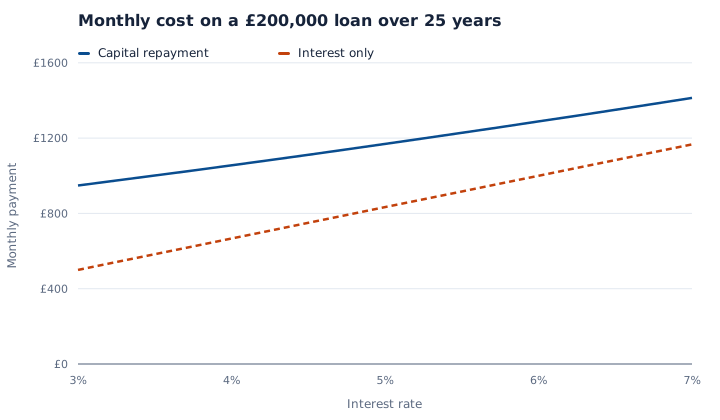
A worked example, step by step
Worked example
£200,000 at 5.25% — interest-only against repayment
- Annual interest: £200,000 × 5.25% = £10,500.
- Monthly interest: £10,500 ÷ 12 = £875.00.
- The repayment equivalent over 25 years is £1,198.50 a month — a difference of £323.50.
- Over 300 months, interest-only costs £262,500 in interest and leaves £200,000 outstanding. The repayment mortgage costs about £159,550 in interest and leaves nothing outstanding.
Monthly saving now: £323.50
Extra interest paid over the term: about £102,950
Put plainly, you save £323.50 a month for 25 years and, at the end of it, you owe £200,000 and have paid roughly £103,000 more in interest for the privilege. That trade only makes sense if the money you did not pay to the lender was doing something more productive elsewhere.
| Interest rate | Monthly cost | Annual interest |
|---|---|---|
| 4.00% | £666.67 | £8,000 |
| 5.25% | £875.00 | £10,500 |
| 6.50% | £1,083.33 | £13,000 |
| 7.50% | £1,250.00 | £15,000 |
Notice how directly a rate change hits you. On a repayment mortgage, a rate rise is partly cushioned by the capital you have already paid off. On interest-only the balance never falls, so the full force of every rate change lands on your payment for the whole term.
What the result does and does not tell you
- It does not include the cost of the repayment vehicle. If you are saving into an ISA or investment to clear the capital, that contribution is part of the true monthly cost. Compared honestly, interest-only is often no cheaper than repayment at all.
- It assumes one rate for the whole term. You will remortgage several times, and the payment recalculates on the same unchanged balance each time.
- It ignores inflation in both directions. Inflation erodes the real value of the debt, which is a genuine argument for interest-only. It also erodes the real value of whatever you are saving to repay it.
- It says nothing about house prices. Planning to repay by selling the property means betting on its value. That can work where there is large equity and a clear downsizing plan; it is not a strategy where the loan is a high proportion of the value.
What lenders do differently from this model
Residential interest-only
After the Mortgage Market Review, residential interest-only lending was tightened sharply, and it never came all the way back. Lenders now generally require a higher minimum income than for an equivalent repayment mortgage, cap the loan-to-value well below the level they would allow on repayment, and insist on documented evidence of your repayment strategy — both when you apply and again at intervals during the term. Where a lender accepts sale of the mortgaged property as the strategy, it will usually also require a minimum amount of equity and a minimum remaining property value.
Buy-to-let
Interest-only is the standard structure for buy-to-let, because interest is an allowable cost against rental income in a way capital repayment is not. Lenders assess these loans on rental cover rather than personal income: they take the expected rent, compare it with the mortgage interest calculated at a stressed rate rather than the pay rate, and require the rent to exceed it by a set margin known as the interest cover ratio.
Last checked August 2026. Interest cover ratios and stress rates are set by each lender and change with the market. Ratios of around 125% for lower-rate taxpayers and limited companies, and around 145% for higher-rate taxpayers, have been common — but confirm the current figures with the lender or your broker rather than relying on a rule of thumb.
Later-life options
Retirement interest-only (RIO) mortgages run on the same monthly arithmetic but have no fixed end date: the capital is repaid when you die or move into long-term care. Lifetime mortgages go further and let the interest roll up instead of being paid. Both are specialist areas with their own advice requirements.
When it is worth speaking to a broker
Interest-only is one of the areas where the choice of lender does most of the work, because criteria differ so widely and almost none of it is visible from the outside. Get advice if you are approaching the end of an existing interest-only term, want part-and-part to bring the payment down without abandoning capital repayment, are self-employed or bonus-reliant and want flexibility in lean months, are buying to let, or are considering a retirement interest-only or later-life product.
The single most useful thing you can do is act early if a term is ending. Two to three years out, you have real options. Six months out, you have very few.
Frequently asked questions
- How is an interest-only mortgage payment calculated?
- Multiply the balance by the annual interest rate, then divide by 12. A £200,000 loan at 5.25% costs £200,000 × 0.0525 ÷ 12 = £875 a month. Because none of the payment reduces the debt, the figure never falls over time — it only changes when the interest rate changes.
- What is a repayment vehicle?
- A repayment vehicle is the credible plan you will use to clear the capital at the end of an interest-only term. Lenders accept things like stocks and shares ISAs, endowment policies, pension tax-free cash, sale of a second property, or sale of the mortgaged property itself where there is substantial equity. They ask for evidence at application and review it during the term.
- Is interest-only cheaper than a repayment mortgage?
- Cheaper monthly, far more expensive overall. On £200,000 at 5.25% over 25 years, interest-only costs £875 a month and £262,500 in total interest, with the full £200,000 still owed. A repayment mortgage costs £1,198.50 a month and about £159,550 in interest, and the debt is gone at the end.
- Can I still get a residential interest-only mortgage in the UK?
- Yes, but criteria are tight. Lenders typically want a higher minimum income, a lower maximum loan-to-value than for a repayment mortgage, and documented evidence of how the capital will be repaid. Availability is far wider for buy-to-let, where interest-only is the normal way of doing things.
- What happens if I reach the end of the term and cannot repay?
- The full balance falls due. If you cannot repay it, options include remortgaging onto a new term, switching to repayment, moving to a retirement interest-only or lifetime mortgage, or selling the property. Lenders are required to treat you fairly, but they can ultimately seek possession, so act two or three years before the term ends rather than at the end.
- Can I switch from interest-only to repayment?
- Usually yes, and lenders rarely object because it lowers their risk. Your payment will rise significantly, since you start repaying capital over the remaining term rather than the original one. Part-and-part is a middle route: some of the balance amortises and the rest stays interest-only, giving a payment between the two.
Keep going
These are the tools and guides people most often need next.
- Interest-only mortgages explained — criteria, repayment strategies and end-of-term options.
- Buy-to-let mortgage guide — where interest-only is the norm rather than the exception.
- Later-life mortgage options — RIO, lifetime mortgages and downsizing.
Guide only. This calculator gives an illustrative estimate and is not regulated mortgage advice or a personal recommendation. Actual figures depend on the lender, product, term, credit profile and your circumstances. Only an FCA-authorised adviser can recommend a product for you. Your home may be repossessed if you do not keep up repayments on your mortgage.
A guide only. With an interest-only mortgage you still owe the original loan at the end of the term and must have a credible repayment strategy. Lender criteria for residential interest-only lending are strict. Speak to a qualified mortgage broker or adviser before committing.
Want a real quote?
Browse independent brokers and advisers who specialise in your situation.
Find a mortgage broker