6 min read · Updated
Should you overpay your mortgage?
What mortgage overpayments actually save, how to choose between cutting the term and cutting the payment, and how overpaying compares with saving, pension contributions and clearing other debt.
Written and reviewed by the MortgageMatch editorial team. How we research and review our guides.
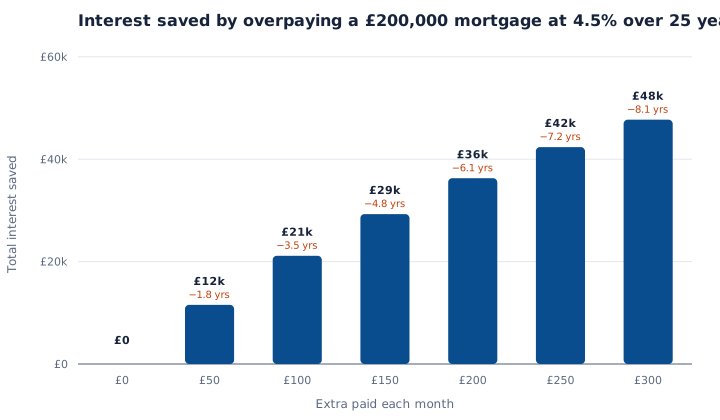
Overpaying your mortgage pays down capital early, so interest is charged on a smaller balance for the rest of the term. The return is effectively guaranteed and equal to your mortgage rate, and it is not taxed. On a 200,000 pound mortgage at an assumed 4.5% over 25 years, an extra 200 pounds a month clears it around six years early and saves roughly 36,000 pounds in interest. Whether it is the best use of your money depends on what else that money could do.
What an overpayment actually does
A normal monthly payment on a repayment mortgage is split between interest and capital. Early in the term most of it is interest. An overpayment is different: every penny goes straight to capital.
That is why overpayments early in the term are worth so much more than the same amount later. Each pound you knock off the balance in year two stops earning the lender interest for twenty-three years. The same pound in year twenty-three saves two years of interest.
It is also why overpaying feels slow at first and then accelerates. Reducing the balance reduces the interest charged next month, which means more of your normal payment goes to capital too, which reduces the balance further.
A worked example over the full term
Take a 200,000 pound repayment mortgage over 25 years. Assume a rate of 4.5% for the whole term, which is an illustration to show the mechanics rather than a prediction or a current market rate.
The monthly payment is about 1,112 pounds. Over 25 years you would pay roughly 333,500 pounds in total, of which about 133,500 pounds is interest.
Now add 200 pounds a month from the start, paying 1,312 pounds. The mortgage clears in around 227 months, which is 18 years and 11 months. Total paid falls to roughly 297,200 pounds, so interest drops to about 97,200 pounds.
You have put in 200 pounds a month for 19 years, roughly 45,300 pounds, and in exchange you have removed about 36,300 pounds of interest and finished six years early. Those six years of freed-up payments, worth around 80,000 pounds, are the part people forget.
Smaller amounts still work. On the same mortgage, 50 pounds a month cuts roughly two years off the term. Rounding a 1,112 pound payment up to 1,150 is nearly painless and still meaningful.
Reduce the term or reduce the payment
When you overpay, most lenders will do one of two things, and it is a genuinely important choice.
Reduce the term keeps your monthly payment the same and shortens the mortgage. All of the benefit compounds into an earlier finish and a much lower total interest bill. This is the option that produces the numbers above.
Reduce the payment keeps the end date the same and recalculates your monthly payment downwards to reflect the smaller balance. You still save interest, but far less, because the saving leaks away each month as a slightly lower payment rather than compounding.
Most lenders default to reducing the payment, or to leaving the payment unchanged without formally shortening the term, which quietly amounts to much the same thing. If your goal is to clear the mortgage sooner, say so explicitly.
The counter-argument for reducing the payment is flexibility. A lower committed monthly payment is a genuine safety net if your income is unstable. Some households sensibly overpay for a lower payment, then keep paying the old amount voluntarily, which gives them the option to stop.
How to tell your lender what you want
Do not just send extra money and hope. Contact the lender, in writing or through their app where it is recorded, and specify three things: that the payment is a capital overpayment, that it should be applied immediately rather than held, and whether you want the term reduced or the payment recalculated.
Ask when overpayments are applied to the balance. Some lenders credit them the day they arrive, others only at a monthly or even annual recalculation date, which can cost you months of benefit. Ask whether a permanently increased direct debit is treated differently from ad hoc payments. And check your annual allowance so you do not stray into an early repayment charge, which is covered in more detail in our article on ERCs.
Overpaying versus saving
Compare the mortgage rate with the after-tax return on savings. If your mortgage is at an assumed 4.5% and an easy access account pays 4%, overpaying wins even before tax. Once you account for tax on the savings interest beyond your personal savings allowance, it wins by more.
Two exceptions. Keep an accessible emergency fund first, ideally three to six months of essential outgoings, because money overpaid into a mortgage is hard to get back. Getting it out means a further advance or a borrow-back facility, and the lender does not have to agree. If flexibility matters to you, an offset mortgage achieves a similar effect while keeping the cash available.
Also check for a genuinely higher-paying option such as a competitive fixed rate bond or a cash ISA that beats your mortgage rate after tax. If one exists, use it.
Overpaying versus pension contributions
Pension contributions attract tax relief at your marginal rate, and workplace schemes often carry an employer match. That match is an immediate return no mortgage overpayment can compete with, so if you are not contributing enough to get your full employer match, do that first.
Beyond the match, it becomes a judgement. Pension money is locked away until your late fifties at the earliest and the investment return is not guaranteed. Mortgage overpayment is certain, available now in the form of lower payments, and improves your loan to value, which can unlock cheaper deals at your next remortgage.
For a higher rate taxpayer with a mortgage at a modest rate, the pension usually looks stronger on paper. For a basic rate taxpayer with an expensive mortgage and a need for security, overpayment often makes more sense. Many people do some of both, and pension decisions are an area where regulated advice is worth paying for.
Overpaying versus other debt
Clear expensive debt first, almost without exception. Credit cards, overdrafts and store cards typically charge far more than any mortgage, so a pound spent there saves several times as much interest. Car finance and personal loans usually sit above mortgage rates too, though check whether early settlement carries a penalty.
The mortgage is normally your cheapest borrowing. It should be near the back of the queue, not the front.
When not to overpay
Do not overpay if you have no emergency savings, if you are carrying expensive short term debt, if you are missing out on an employer pension match, or if you are within touching distance of an early repayment charge. Do not overpay if you expect to move soon and will need the cash for the deposit or costs.
And be honest about the emotional side. Some people value being mortgage-free more than they value an optimal spreadsheet, and that is a legitimate reason as long as the basics above are covered.
A sensible order of priorities is this. Emergency fund, then expensive debt, then employer pension match, then a considered split between mortgage overpayment and further pension contributions based on your tax position and how much certainty you want.
If you want to check how overpayments interact with your specific product terms and allowances, the MortgageMatch directory lists FCA-authorised brokers who can review the small print with you.
Frequently asked questions
- Is it better to overpay my mortgage or save the money?
- Overpaying usually wins if your mortgage rate is higher than the after-tax return on your savings, which it often is. Build an accessible emergency fund of three to six months of essential outgoings first, though, because overpaid money is difficult to get back. An offset mortgage can give you a similar benefit while keeping the cash available.
- Should I reduce the term or reduce the monthly payment when I overpay?
- Reducing the term saves considerably more interest, because your payment stays the same and the whole benefit compounds into an earlier finish. Reducing the payment lowers your monthly outgoing but leaks most of the saving away. Many lenders default to reducing the payment, so tell them explicitly which you want when you make the overpayment.
- How much can I overpay my mortgage each year?
- Most lenders allow up to 10 per cent of the outstanding balance a year without an early repayment charge, but the figure and how it is measured vary. Check whether the allowance is based on the balance at the start of the calendar year or the mortgage anniversary, whether unused allowance carries over, and whether your normal payments count towards it.
- Does overpaying my mortgage reduce my monthly payment?
- Only if you ask for that. Lenders can apply an overpayment either by recalculating your monthly payment downwards over the same term, or by keeping the payment the same and shortening the term. Tell your lender which you want in writing, and ask when overpayments are applied to the balance, as some only recalculate at set points in the year.
- Is it better to overpay my mortgage or pay into a pension?
- Get any employer pension match first, as that is an immediate return no overpayment can match. Beyond that it depends on your tax rate and your appetite for certainty. Pension contributions get tax relief but are locked away and not guaranteed. Overpaying gives a certain, untaxed return and improves your loan-to-value for your next deal.
This guide is general information about how UK mortgages work, not a personal recommendation. Only an FCA-authorised adviser can recommend a product for your circumstances. Tax and scheme rules change, so check the relevant government source before you budget.
Related guides
- Early repayment charges: how to avoid ERCs on your mortgageHow early repayment charges are calculated and tapered, what triggers them, how the annual overpayment allowance works, and when paying an ERC to switch deals is still the cheaper option.
- Porting a mortgage: keeping your rate when you moveHow porting works when you move house, why you have to requalify, how sub-accounts and blended rates work if you borrow more, what happens if your sale and purchase do not line up, and when remortgaging beats porting.
- When to remortgage, and how to do itHow to time a remortgage, how a product transfer differs from moving lender, the realistic timeline, the costs involved, and when staying put is the better call.